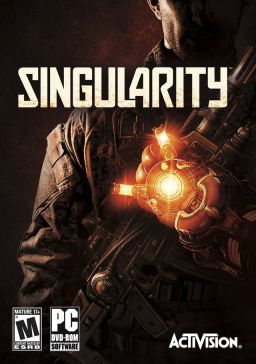
Singularity is a video game developed by Raven Software published by Activision and released for Microsoft Windows, Xbox 360, and PlayStation 3, Singularity is Raven Software's second title based on Epic Games' Unreal Engine 3. The title was announced at Activision's E3 2008 press conference.
The game takes place on a mysterious island known as "Katorga-12" where Russian experiments involving "E99" took place during the height of the Cold War era. Sometime during 1955, a terrible catastrophe involving experiments attempting to form a "Singularity" occurred on the island, causing the island's very existence to be covered up by the Russian government. The player controls Nate Renko, a Black Ops soldier who is sent to investigate bizarre radiation emissions coming from the island. The operation goes poorly when team crashes during transport and the operation is scrapped. After regaining consciousness, Renko discovers that the island is constantly shifting between the time periods of 1955 and 2010. Renko acidentally shifts the timeline by saving a scientist who died in 1955. Renko finds the TMD (Time Manipulation Device), a device created by Dr. Victor Barisov. Barisov, the scientist who was in charge of the Katorga-12 experiments, reveals that a man named Nikolai Demichev, also a scientist on Katorga-12, used E99 technology to conquer the world. During the quest to stop Demichev, the player deals with hostile Russian forces in both time periods, and the mutated flora, fauna and former residents of the island, some of which have developed extreme power of their own.
In response to the United States' development and deployment of the atomic bomb, Joseph Stalin makes nuclear research the top scientific priority of the USSR. On a small island near Kamchatka, scientists discover an isotope of E99 that has strange properties. A research base named Katorga-12 is established on the island. E99-related research continued on the island until late 1955, when the island was destroyed by an accident. The Soviet government then erased any information about Katorga-12 and suppressed public knowledge of the accident.
In 2010, a sudden electromagnetic surge from Katorga-12 damages an American spy satellite. A military reconnaissance team is sent to investigate the uninhabited island, but a second surge causes their helicopter to crash. Captain Nathaniel Renko, a member of the reconnaissance team, enters the abandoned scientific complex on the island, where he phases between 1955 and 2010.
Renko is first transported back to 1955 during a major fire at the facility, where he saves one Nikolai Demichev. As this happens, an unidentified man yells, "Renko, stop! Don't let Demichev live!", before being killed by a ceiling collapse. Dr. Demichev would have otherwise died in the fire; by rescuing him, Renko altered history. Renko is abruptly returned to the year 2010, where he discovers that the island has changed. He encounters strange and violent creatures, and regroups with Devlin, a second survivor of the helicopter crash. Both soldiers are captured by Russian soldiers under the command of Demichev. Devlin demands asylum at the American embassy, at which point he is executed by Demichev.
Renko is saved by an organization called Mir-12. Mir-12 is a secretive resistance organization that bases its existence off of a journal recovered from the accident on Katorga-12. The journal declares that Nathaniel Renko will be able to stop Demichev using the "TMD", or "Time Manipulation Device". This device was apparently created by Dr. Viktor Barisov, who died in a laboratory accident, leaving Demichev to command the research base and eventually rule the world. Kathryn tells Renko to find the TMD and use it to go back in time and save Barisov. Renko succeeds and returns to 2010, where Barisov is now alive and well.
Barisov and Renko plan to fix history by going back in time and destroying the island's Singularity tower with an E-99 bomb. Renko recovers an E99 bomb from a sunken ship (the Pearl), but Kathryn dies in the process.
Renko and Barisov then fight their way into the Singularity Tower, which lies at the heart of Katorga-12. When they reach the tower's reactor, Renko travels back in time and uses the E99 bomb to destroy the reactor; he returns to 2010 moments before the tower is destroyed. It is implied that this explosion triggered the destruction of the Singularity and mutated the island's population.
Upon returning to 2010, Renko finds that nothing has changed. He sees Demichev holding Barisov at gunpoint. Demichev reveals that he rebuilt the facility after the bomb was detonated (presumably at another location). Renko shoots and non-fatally wounds Demichev, freeing Barisov. Barisov realizes that Demichev's rescue is what altered the timeline, and tells Renko that the only way to fix the timeline is for Renko to go back in time and stop himself from rescuing Demichev. Demichev reveals that Renko already tried that; he was the unidentified man that Renko saw in the fire. The three realize that the only way for Renko to stop Demichev's rescue is to kill his past self. Demichev offers Renko unlimited power in exchange for the TMD. The player is left with a choice resulting in three endings, based on whether Renko shoots Demichev, Barisov, or both men.
If the player shoots Barisov, he joins forces with Demichev and the team succeed in taking over most of the world, with Renko training the Katorga-12 mutants as soldiers and using them as first wave attackers in all of his battles. But with his control of the TMD, Demichev feels Renko is even more powerful than he is and takes precautionary measures against him by starting a weapons research program in the former United States. This settles the world into another Cold War with Renko on one side and Demichev on the other, although Renko is most likely to win, seeing he has almost complete control over the East and his power is slowly consuming the West.
If the player shoots both Demichev and Barisov, Renko leaves Katorga-12 and allows the world to fall into chaos. The public believes his very existence to be a myth as he disappears with the TMD in his possession. The Singularity explodes some years later and destroys the eastern coast of Russia and the Western coast of Alaska. Katorga-12 mutants escape onto mainland Russia and wreak havoc. A new leader rises in the former United States and is reported to be very aggressive and tyrannical as he leads the entire world with an iron fist. The in-game cutscenes and narration heavily imply the leader to be Renko himself.
If the player chooses to kill Demichev, or if he shoots neither man, then Barisov urges Renko to go back in time and stop himself from rescuing Demichev by killing his past self. The player then assumes the position of the man who shouted at Renko in the fire, only instead of being crushed by debris, he shoots the past Renko. Shooting the past version of Renko sends the narrative back to Devlin and Renko's arrival at Katorga-12. The game's intro credits are shown written in Russian, the helicopters bear the hammer and sickle on the side, and Devlin, armed with a Russian weapon, comments that monitoring Katorga-12 is a waste of time. The helicopter moves past the statue seen in the intro credits, but it has changed into a massive monument to Barisov wearing the TMD. Renko seems to have retained his memories from the rest of the game, as he checks his left hand when he sees the monument. Renko and Devlin's mission is called off by their dispatcher -- Red Fleet instead of Titan One -- and Devlin refers to Renko as "comrade". It is implied that Barisov recovered the TMD from the fire and used it to unite the world under Soviet rule.
A post-credit scene shows a wounded Kathryn emerging in 1955 from the Pearl's wreckage and hiding in an office. Bleeding heavily, she writes "Renko" in the Mir-12 journal.

