26 Ağustos 2010 Perşembe

Single Point of Failure

A single point of failure (SPOF) is a part of a system which, if it fails, will stop the entire system from working. They are undesirable in any system whose goal is high availability, be it a network, software application or other industrial system.


The assessment of a potentially single location of failure identifies the critical components of a complex system that would provoke a total systems failure in case of malfunction. Highly reliable systems may not rely on any such individual component.

20 Ağustos 2010 Cuma

Deep Crack


In cryptography, the EFF DES cracker (nicknamed "Deep Crack") is a machine built by the Electronic Frontier Foundation (EFF) in 1998 to perform a brute force search of DES cipher's key space — that is, to decrypt an encrypted message by trying every possible key. The aim in doing this was to prove that DES's key is not long enough to be secure.

DES uses a 56-bit key, meaning that there are 2^56 possible keys under which a message can be encrypted. This is exactly 72,057,594,037,927,936, or approximately 72 quadrillion, possible keys. When DES was approved as a federal standard in 1976, a machine fast enough to test that many keys in a reasonable time would have cost an unreasonable amount of money to build.

Deep Crack was designed by Cryptography Research, Inc., Advanced Wireless Technologies and the EFF. The principal designer was Paul Kocher, president of Cryptography Research. Advanced Wireless Technologies built 1856 custom ASIC DES chips (called Deep Crack or AWT-4500), housed on 29 circuit boards of 64 chips each. The boards were then fitted in six cabinets and mounted in a Sun-4/470 chasis. The search was coordinated by a single PC which assigned ranges of keys to the chips. The entire machine was capable of testing over 90 billion keys per second. It would take about 9 days to test every possible key at that rate. On average, the correct key would be found in half that time.


In 2006, another custom hardware attack machine was designed based on FPGAs. COPACOBANA (COst-optimized PArallel COdeBreaker) shows a similar performance as Deep Crack at considerably lower cost. This advantage is mainly due to progress in IC technology.

Since DES was a federal standard, the US government encouraged the use of DES for all non-classified data. RSA Security wished to demonstrate that DES's key length was not enough to ensure security, so they set up the DES Challenges in 1997, offering a monetary prize. The first DES Challenge was solved in 96 days by the DESCHALL Project led by Rocke Verser in Loveland, Colorado. RSA Security set up DES Challenge II-1, which was solved by distributed.net in 41 days in January and February 1998.


In 1998, the EFF built Deep Crack for less than $250,000. In response to DES Challenge II-2, on July 17, 1998, Deep Crack decrypted a DES-encrypted message after only 56 hours of work, winning $10,000. This was the final blow to DES, against which there were already some published cryptanalytic attacks. The brute force attack showed that cracking DES was actually a very practical proposition. For well-endowed governments or corporations, building a machine like Deep Crack would be no problem.

Six months later, in response to RSA Security's DES Challenge III, and in collaboration with distributed.net, the EFF used Deep Crack to decrypt another DES-encrypted message, winning another $10,000. This time, the operation took less than a day — 22 hours and 15 minutes. The decryption was completed on January 19, 1999. In October of that year, DES was reaffirmed as a federal standard, but this time the standard recommended Triple DES (also referred to as 3DES or TDES).

The small key-space of DES, and relatively high computational costs of triple DES resulted in its replacement by AES as a Federal standard, effective May 26, 2002.

14 Ağustos 2010 Cumartesi

Rubik's Cube


The Rubik's Cube is a 3-D mechanical puzzle invented in 1974 by Hungarian sculptor and professor of architecture Ernő Rubik. Originally called the "Magic Cube", the puzzle was licensed by Rubik to be sold by Ideal Toys in 1980 and won the German Game of the Year special award for Best Puzzle that year. As of January 2009, 350 million cubes have sold worldwide making it the world's top-selling puzzle game. It is widely considered to be the world's best-selling toy.

In a classic Rubik's Cube, each of the six faces is covered by nine stickers, among six solid colours (traditionally white, red, blue, orange, green, and yellow). A pivot mechanism enables each face to turn independently, thus mixing up the colours. For the puzzle to be solved, each face must be a solid colour. Similar puzzles have now been produced with various numbers of stickers, not all of them by Rubik. The original 3×3×3 version celebrates its thirtieth anniversary in 2010.

There are many algorithms to solve scrambled Rubik's Cubes. The minimum number of face turns needed to solve any instance of the Rubik's cube is 20. This number is also known as the diameter of the Cayley graph of the Rubik's Cube group. An algorithm that solves a cube in the minimum number of moves is known as God's algorithm.

There are two common ways to measure the length of a solution. The first is to count the number of quarter turns. The second is to count the number of face turns. A move like F2 (a half turn of the front face) would be counted as 2 moves in the quarter turn metric and as only 1 turn in the face metric.

In 2006, Silviu Radu further improved his methods to prove that every position can be solved in at most 27 face turns or 35 quarter turns. Daniel Kunkle and Gene Cooperman in 2007 used a supercomputer to show that all unsolved cubes can be solved in no more than 26 moves (in face-turn metric). Instead of attempting to solve each of the billions of variations explicitly, the computer was programmed to bring the cube to one of 15,000 states, each of which could be solved within a few extra moves. All were proved solvable in 29 moves, with most solvable in 26. Those that could not initially be solved in 26 moves were then solved explicitly, and shown that they too could be solved in 26 moves.

Tomas Rokicki reported in 2008 computational proof that all unsolved cubes could be solved in 25 moves or fewer. This was later reduced to 23 moves. In August 2008 Rokicki announced that he had a proof for 22 moves. In 2009, Tomas Rokicki proved that 29 moves in quarter turn metric is enough to solve any scrambled cube. Finally, in 2010, an international Group around Morley Davidson gave the final proof that all cube positions could be solved with a maximum of 20 face turns.

28 Temmuz 2010 Çarşamba

Metallic Hydrogen

Metallic hydrogen is a state of hydrogen which results when it is sufficiently compressed and undergoes a phase transition; it is an example of degenerate matter. Solid metallic hydrogen is predicted to consist of a crystal lattice of hydrogen nuclei (namely, protons), with a spacing which is significantly smaller than the Bohr radius. Indeed, the spacing is more comparable with the de Broglie wavelength of the electron. The electrons are unbound and behave like the conduction electrons in a metal. In liquid metallic hydrogen, protons do not have lattice ordering; rather, it is a liquid system of protons and electrons.

Liquid metallic hydrogen

Helium-4 is a liquid at normal pressure and temperatures near absolute zero, a consequence of its high zero-point energy (ZPE). The ZPE of protons in a dense state is also high, and a decline in the ordering energy (relative to the ZPE) is expected at high pressures. Arguments have been advanced by Neil Ashcroft and others that there is a melting point maximum in compressed hydrogen, but also that there may be a range of densities (at pressures around 400 GPa) where hydrogen may be a liquid metal, even at low temperatures.

Astrophysics

Metallic hydrogen is thought to be present in large amounts in the gravitationally compressed interiors of Jupiter, Saturn, and some of the newly discovered extrasolar planets. Because previous predictions of the nature of those interiors had taken for granted metallization at a higher pressure than the one at which we now know it to happen, those predictions must now be adjusted. The new data indicate much more metallic hydrogen must exist inside Jupiter than previously thought, that it comes closer to the surface, and that therefore, Jupiter's tremendous magnetic field, the strongest of any planet in the solar system is, in turn, produced closer to the surface.

25 Temmuz 2010 Pazar

PSPgo


The PSP Go (model PSP-N1000) is a version of the PlayStation Portable handheld video game console manufactured by Sony. It was released on October 1, 2009 in American and European territories[1] and on November 1 in Japan. It was revealed prior to E3 2009 through Sony's Qore VOD service. Although its design is significantly different from other PSPs, it is not intended to replace the PSP 3000, which Sony will continue to manufacture, sell, and support.

Unlike previous PSP models, the PSP Go does not feature a UMD drive, but instead has 16GB of internal flash memory to store games, video, pictures, and other media.[12] This can be extended by up to 32GB with the use of a Memory Stick Micro (M2) flash card. Also unlike previous PSP models, the PSP Go's rechargeable battery is not removable or replaceable by the user. The unit is 43% lighter and 56% smaller than the original PSP-1000, and 16% lighter and 35% smaller than the PSP-3000.[6] It has a 3.8" 480×272 LCD[13] (compared to the larger 4.3" 480×272 pixel LCD on previous PSP models). The screen slides up to reveal the main controls.

The PSP Go features 802.11b Wi-Fi like its predecessors, but no longer uses a standard USB A-to-Mini-B cable common with many devices. A new proprietary multi-use connector is used for USB connectivity. A suitable USB cable is included with the unit. The new multi-use connector allows for charging and USB similar to previous units, but also allows video and sound output with the same connector (with optional Composite AV cable and Component AV cable), unlike previous offerings which had TV OUT functionality on a separate port to the USB port. Sony also offers an optional cradle for charging and USB data transfer on the PSP Go, similar to previous offerings.


Generation: Seventh
Retail availability
* NA/EU October 1, 2009[1]
* JP November 1, 2009[2]
CPU: MIPS 333 MHz[5]
Storage capacity: Memory Stick M2, 16GB of internal flash memory
Memory: 64 MB RAM
Display: 480 x 272 pixels with 16.8 million colours, 16:9 widescreen TFT LCD, 3.8 in (97 mm)
Connectivity: Wi-Fi 802.11b, USB 2.0 via Media Go Software, Bluetooth 3.0, PlayStation 3
Dimensions:
69 mm (2.7 in) (h)
128 mm (5.0 in) (w)
16.5 mm (0.65 in) (d)
Weight: 158 grams

24 Temmuz 2010 Cumartesi

Eris


Eris, formal designation 136199 Eris, is the largest known dwarf planet in the Solar System and the ninth-largest body known to orbit the Sun directly. It is approximately 2,500 kilometres in diameter and 27% more massive than Pluto.

Eris was first identified in January 2005 by a Palomar Observatory-based team led by Mike Brown, and its identity verified later that year. It is a trans-Neptunian object (TNO) native to a region of space beyond the Kuiper belt known as the scattered disc. Eris has one moon, Dysnomia; recent observations have found no evidence of further satellites. The current distance from the Sun is 96.7 AU, roughly three times that of Pluto. With the exception of some comets the pair are the most distant known natural objects in the Solar System.

Because Eris is larger than Pluto, its discoverers and NASA initially described it as the Solar System’s tenth planet. This, along with the prospect of other similarly sized objects being discovered in the future, motivated the International Astronomical Union (IAU) to define the term planet for the first time. Under a then-new IAU definition approved on August 24, 2006, Eris is a "dwarf planet" along with Pluto, Ceres, Haumea and Makemake.

Eris is named after the Greek goddess Eris, a personification of strife and discord. The name was assigned on September 13, 2006 following an unusually long period in which it was known by the provisional designation 2003 UB313, which was granted automatically by the IAU under their naming protocols for minor planets. The regular adjectival form of Eris is Eridian.

Orbit
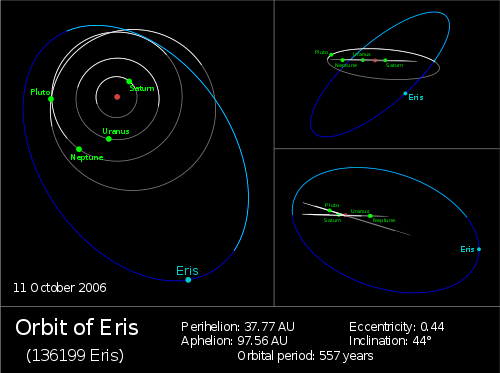


Eris has an orbital period of 557 years, and as of 2009 lies at 96.7 astronomical units from the Sun, almost its maximum possible distance. (Its aphelion is 97.5 AU.) Eris came to perihelion between 1698 and 1699, to aphelion around 1977, and will return to perihelion around 2256[34] to 2258. Eris and its moon are currently the most distant known objects in the Solar System apart from long-period comets and space probes. However, approximately forty known TNOs, most notably 2000 OO67 and Sedna, while currently closer to the Sun than Eris, have greater average orbital distances than Eris' semimajor axis of 67.7 AU.

The Eridian orbit is highly eccentric, and brings Eris to within 37.9 AU of the Sun, a typical perihelion for scattered objects. This is within the orbit of Pluto, but still safe from direct interaction with Neptune (29.8–30.4 AU). Pluto, on the other hand, like other plutinos, follows a less inclined and less eccentric orbit and, protected by orbital resonance, can cross Neptune’s orbit. (It is possible that Eris is in a 17:5 resonance with Neptune, though further observations will be required to know for sure.[37]) Unlike the eight planets, whose orbits all lie roughly in the same plane as the Earth's, Eris' orbit is highly inclined: It is tilted at an angle of about 44 degrees to the ecliptic. In about 800 years, Eris will be closer to the Sun than Pluto for some time.

Eris currently has an apparent magnitude of 18.7, making it bright enough to be detectable to some amateur telescopes. A 200 mm telescope with a CCD can detect Eris under favorable conditions. The reason it had not been noticed until now is because of its steep orbital inclination; most searches for large outer Solar System objects concentrate on the ecliptic plane, where most bodies are found.

Eris is now in the constellation Cetus. It was in Sculptor from 1876 until 1929 and Phoenix from roughly 1840 until 1875. In 2036 it will enter Pisces and stay there until 2065, when it will enter Aries. It will then move into the northern sky, entering Perseus in 2128 and Camelopardalis (where it will reach its northernmost declination) in 2173. Because the orbit of Eris is highly inclined, it only passes through a few constellations of the traditional Zodiac.

Size, mass, and density

The diameter of Eris has been measured to be 2,397 km, give or take 100 km, using images from the Hubble Space Telescope (HST).[38][39] The size of an object depends on its absolute magnitude and the albedo (the amount of light it reflects). At a distance of 97 AU, an object with a radius of 3,000 km would have an angular size of 40 milliarcseconds, which is directly measurable with the HST; although resolving such small objects is at the very limit of Hubble's capabilities, sophisticated image processing techniques such as deconvolution can be used to measure such angular sizes fairly accurately.)

This makes Eris only 0-8% larger than Pluto, which is about 2,306 km across. It also indicates an albedo of 0.86, higher than any other large body in the Solar System other than Enceladus. It is speculated that the high albedo is due to the surface ices being replenished due to temperature fluctuations as Eris' eccentric orbit takes it closer and farther from the Sun.

In 2007, a series of observations of the largest trans-Neptunian objects with the Spitzer Space Telescope gave an estimate of Eris's diameter of 2,600 (+400; -200) km.[8] The Spitzer and Hubble estimates overlap in the range of 2,400-2,500 km, 4-8% larger than Pluto.

The mass of Eris can be calculated with much greater precision. Based on the currently accepted value for Dysnomia's period, 15.774 days, Eris is 27 percent more massive than Pluto.

16 Temmuz 2010 Cuma

HTML5

HTML5 is currently under development as the next major revision of the HTML standard. Like its immediate predecessors, HTML 4.01 and XHTML 1.1, HTML5 is a standard for structuring and presenting content on the World Wide Web. The new standard incorporates features like video playback and drag-and-drop that have been previously dependent on third-party browser plug-ins such as Adobe Flash, Microsoft Silverlight, and Google Gears.

The Web Hypertext Application Technology Working Group (WHATWG) started work on the specification in June 2004 under the name Web Applications 1.0.[1] As of March 2010, the specification is in the Draft Standard state at the WHATWG, and in Working Draft state at the W3C. Ian Hickson of Google, Inc. is the editor of HTML5.

The HTML5 specification was adopted as the starting point of the work of the new HTML working group of the World Wide Web Consortium (W3C) in 2007. This working group published the First Public Working Draft of the specification on January 22, 2008. The specification is an ongoing work, and is expected to remain so for many years, although parts of HTML5 are going to be finished and implemented in browsers before the whole specification reaches final Recommendation status.

According to the W3C timetable, it is estimated that HTML5 will reach W3C Recommendation by late 2010. However, the First Public Working Draft estimate was missed by 8 months, and Last Call and Candidate Recommendation were expected to be reached in 2008, but as of July 2010 HTML5 is still at Working Draft stage in the W3C. HTML5 has been at Last Call in the WHATWG since October 2009.

Markup

HTML5 introduces a number of new elements and attributes that reflect typical usage on modern websites. Some of them are semantic replacements for common uses of generic block (
) and inline () elements, for example