solar system etiketine sahip kayıtlar gösteriliyor. Tüm kayıtları göster

18 Eylül 2010 Cumartesi

Sedna


90377 Sedna is a trans-Neptunian object, discovered in 2003, which currently lies about three times as far from the Sun as Neptune. However, its farthest orbital distance from the Sun is estimated to be 960 astronomical units (AU), and thus it is, for the majority of its orbit, the most distant known object in the Solar System after long-period comets.

Roughly two-thirds the size of Pluto, Sedna is hypothetically large enough to be rounded by its own gravity, and thus would qualify as a dwarf planet under current definitions. However, its distance from the Sun makes determining its shape difficult. Spectroscopy has revealed that Sedna's surface composition is similar to that of some other trans-Neptunian objects, being largely a mixture of water, methane and nitrogen ices with tholins. Its surface is one of the reddest in the Solar System.

Sedna's exceptionally long and elongated orbit, taking approximately 12,000 years to complete, and distant point of closest approach to the Sun, at 76 AU, have led to much speculation as to its origin. The Minor Planet Center currently places Sedna in the scattered disc, a group of objects sent into highly elongated orbits by the gravitational influence of Neptune. However, this classification has been contested, as Sedna never comes close enough to Neptune to have been scattered by it, leading some astronomers to conclude that it is in fact the first known member of the inner Oort cloud. Others speculate that it might have been tugged into its current orbit by a passing star, perhaps one within the Sun's birth cluster, or even that it was captured from another star system. Another hypothesis suggests that its orbit may be evidence for a large planet beyond the orbit of Neptune. Astronomer Mike Brown, who co-discovered Sedna as well as the dwarf planets Eris, Haumea, and Makemake, believes it to be the most scientifically important trans-Neptunian object found to date, as understanding its peculiar orbit is likely to yield valuable information about the origin and early evolution of the Solar System.

Orbit and rotation

Barring comets, Sedna has the longest orbital period of any known object in the Solar System, calculated at between 11,800 and 12,100 years. This represents a best-fit solution, as Sedna has only been observed over a brief part of its orbital arc. Its orbit is extremely elliptical, with an aphelion estimated at 960 AU and a perihelion at about 76 AU. At its discovery it was approaching perihelion at 89.6 AU from the Sun, and was the most distant object in the Solar System yet observed. Eris was later detected by the same survey at 97 AU. Although the orbits of some long-period comets extend farther than that of Sedna, they are too dim to be discovered except when approaching perihelion in the inner Solar System. Even as Sedna nears its perihelion in late 2075 to mid 2076, the Sun would appear merely as a bright star in its sky: with an angular diameter too small to resolve as a disc, it would be only 100 times brighter than a full Moon on Earth.


When first discovered, Sedna was believed to have an unusually long rotational period (20 to 50 days). It was initially speculated that Sedna's rotation was slowed by the gravitational pull of a large binary companion, similar to Pluto's moon Charon. A search for such a satellite by the Hubble Space Telescope in March 2004 found nothing, and subsequent measurements from the MMT telescope suggest a much shorter rotation period, only about 10 hours, rather typical for bodies of its size.

24 Temmuz 2010 Cumartesi

Eris


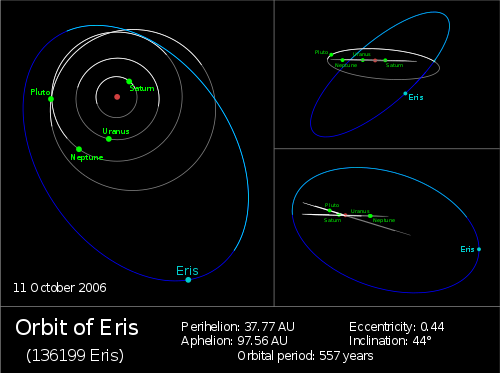
Eris, formal designation 136199 Eris, is the largest known dwarf planet in the Solar System and the ninth-largest body known to orbit the Sun directly. It is approximately 2,500 kilometres in diameter and 27% more massive than Pluto.

Eris was first identified in January 2005 by a Palomar Observatory-based team led by Mike Brown, and its identity verified later that year. It is a trans-Neptunian object (TNO) native to a region of space beyond the Kuiper belt known as the scattered disc. Eris has one moon, Dysnomia; recent observations have found no evidence of further satellites. The current distance from the Sun is 96.7 AU, roughly three times that of Pluto. With the exception of some comets the pair are the most distant known natural objects in the Solar System.

Because Eris is larger than Pluto, its discoverers and NASA initially described it as the Solar System’s tenth planet. This, along with the prospect of other similarly sized objects being discovered in the future, motivated the International Astronomical Union (IAU) to define the term planet for the first time. Under a then-new IAU definition approved on August 24, 2006, Eris is a "dwarf planet" along with Pluto, Ceres, Haumea and Makemake.

Eris is named after the Greek goddess Eris, a personification of strife and discord. The name was assigned on September 13, 2006 following an unusually long period in which it was known by the provisional designation 2003 UB313, which was granted automatically by the IAU under their naming protocols for minor planets. The regular adjectival form of Eris is Eridian.

Orbit


Eris has an orbital period of 557 years, and as of 2009 lies at 96.7 astronomical units from the Sun, almost its maximum possible distance. (Its aphelion is 97.5 AU.) Eris came to perihelion between 1698 and 1699, to aphelion around 1977, and will return to perihelion around 2256[34] to 2258. Eris and its moon are currently the most distant known objects in the Solar System apart from long-period comets and space probes. However, approximately forty known TNOs, most notably 2000 OO67 and Sedna, while currently closer to the Sun than Eris, have greater average orbital distances than Eris' semimajor axis of 67.7 AU.

The Eridian orbit is highly eccentric, and brings Eris to within 37.9 AU of the Sun, a typical perihelion for scattered objects. This is within the orbit of Pluto, but still safe from direct interaction with Neptune (29.8–30.4 AU). Pluto, on the other hand, like other plutinos, follows a less inclined and less eccentric orbit and, protected by orbital resonance, can cross Neptune’s orbit. (It is possible that Eris is in a 17:5 resonance with Neptune, though further observations will be required to know for sure.[37]) Unlike the eight planets, whose orbits all lie roughly in the same plane as the Earth's, Eris' orbit is highly inclined: It is tilted at an angle of about 44 degrees to the ecliptic. In about 800 years, Eris will be closer to the Sun than Pluto for some time.

Eris currently has an apparent magnitude of 18.7, making it bright enough to be detectable to some amateur telescopes. A 200 mm telescope with a CCD can detect Eris under favorable conditions. The reason it had not been noticed until now is because of its steep orbital inclination; most searches for large outer Solar System objects concentrate on the ecliptic plane, where most bodies are found.

Eris is now in the constellation Cetus. It was in Sculptor from 1876 until 1929 and Phoenix from roughly 1840 until 1875. In 2036 it will enter Pisces and stay there until 2065, when it will enter Aries. It will then move into the northern sky, entering Perseus in 2128 and Camelopardalis (where it will reach its northernmost declination) in 2173. Because the orbit of Eris is highly inclined, it only passes through a few constellations of the traditional Zodiac.

Size, mass, and density

The diameter of Eris has been measured to be 2,397 km, give or take 100 km, using images from the Hubble Space Telescope (HST).[38][39] The size of an object depends on its absolute magnitude and the albedo (the amount of light it reflects). At a distance of 97 AU, an object with a radius of 3,000 km would have an angular size of 40 milliarcseconds, which is directly measurable with the HST; although resolving such small objects is at the very limit of Hubble's capabilities, sophisticated image processing techniques such as deconvolution can be used to measure such angular sizes fairly accurately.)

This makes Eris only 0-8% larger than Pluto, which is about 2,306 km across. It also indicates an albedo of 0.86, higher than any other large body in the Solar System other than Enceladus. It is speculated that the high albedo is due to the surface ices being replenished due to temperature fluctuations as Eris' eccentric orbit takes it closer and farther from the Sun.

In 2007, a series of observations of the largest trans-Neptunian objects with the Spitzer Space Telescope gave an estimate of Eris's diameter of 2,600 (+400; -200) km.[8] The Spitzer and Hubble estimates overlap in the range of 2,400-2,500 km, 4-8% larger than Pluto.

The mass of Eris can be calculated with much greater precision. Based on the currently accepted value for Dysnomia's period, 15.774 days, Eris is 27 percent more massive than Pluto.

23 Ocak 2008 Çarşamba

Comet Shoemaker-Levy 9


Hubble Space Telescope image of Comet Shoemaker-Levy 9, taken on May 17, 1994.

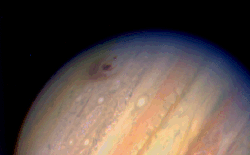
Comet Shoemaker-Levy 9 (SL9, formally designated D/1993 F2) was a comet that collided with Jupiter in 1994, providing the first direct observation of the collision of two solar system objects, not including collisions involving Earth. This generated a large amount of coverage in the popular media, and SL9 was closely observed by astronomers worldwide. The comet provided many revelations about Jupiter and its atmosphere and highlighted Jupiter's role in reducing space debris in the inner solar system.


The comet was discovered by astronomers Carolyn and Eugene M. Shoemaker and David Levy. Shoemaker-Levy 9 was located on the night of March 24, 1993, in a photograph taken with the 0.4-metre Schmidt telescope at the Mount Palomar Observatory in California. It was the first comet observed to be orbiting a planet rather than the Sun.


SL9 was in pieces ranging in size up to 2 kilometres in diameter, and is believed to have been pulled apart by Jupiter's tidal forces during a close encounter in July 1992. These fragments collided with Jupiter's southern hemisphere between July 16 and July 22, 1994, at a speed of approximately 60 kilometres per second. The prominent scars from the impacts could be seen on Jupiter for many months after the impact, and observers described them as more easily visible than the Great Red Spot.


One of the surprises of the impacts was the small amount of water revealed compared to prior predictions. Before the impact, models of Jupiter's atmosphere had indicated that the break-up of the largest fragments would occur at atmospheric pressures of anywhere from 300 kilopascals to a few megapascals (from three to a few tens bar), and most astronomers expected that the impacts would penetrate a hypothesised water-rich layer underneath the clouds.

Astronomers did not observe large amounts of water following the collisions, and later impact studies found that fragmentation and destruction of the cometary fragments in an 'airburst' probably occurred at much higher altitudes than previously expected, with even the largest fragments being destroyed when the pressure reached 250 kPa (2.5 bar), well above the expected depth of the water layer. The smaller fragments were probably destroyed before they even reached the cloud layer.

The visible scars from the impacts could be seen on Jupiter for many months after the impact. They were extremely prominent, and observers described them as more easily visible even than the Great Red Spot. A search of historical observations revealed that the spots were probably the most prominent transient features ever seen on the planet, and that while the Great Red Spot is notable for its striking colour, no spots of the size and darkness of those caused by the SL9 impacts have ever been recorded before.

Spectroscopic observers found that ammonia and carbon sulfide persisted in the atmosphere for at least fourteen months after the collisions, with a considerable amount of ammonia being present in the stratosphere as opposed to its normal location in the troposphere.

Counterintuitively, the atmospheric temperature dropped to normal levels much more quickly at the larger impact sites than at the smaller sites: at the larger impact sites, temperatures were elevated over a region 15,000–20,000 km wide, but dropped back to normal levels within a week of the impact. At smaller sites, temperatures 10 K higher than the surroundings persisted for almost two weeks. Global stratospheric temperatures rose immediately after the impacts, then fell to below pre-impact temperatures 2–3 weeks afterwards, before rising slowly to normal temperatures.

17 Eylül 2007 Pazartesi

MESSENGER (NASA)


MESSENGER NASA Official

The MErcury Surface, Space ENvironment, GEochemistry and Ranging (or MESSENGER for short) is a NASA mission, launched August 3, 2004, designed to study the characteristics and environment of Mercury from orbit. Specifically, the scientific objectives of the mission are to characterize the chemical composition of Mercury's surface, the geologic history, the nature of the magnetic field, the size and state of the core, the volatile inventory at the poles, and the nature of Mercury's exosphere and magnetosphere over a nominal orbital mission of one Earth year. The mission will be the first to return to Mercury in over 35 years — the only previous probe to visit Mercury was Mariner 10, which completed its mission in March, 1975. MESSENGER will offer several vast improvements in scanning ability, with cameras that can resolve surface features down to just 60 feet across (18 meters) compared to the one mile (1.61 kilometer) resolution offered by Mariner 10. MESSENGER will also be the first probe to image the entire planet; Mariner 10 was only able to observe one hemisphere that was lit during its flybys.


In addition to being an acronym, MESSENGER was chosen as the probe's name because Mercury was the messenger of the gods in Roman mythology.

15 Eylül 2007 Cumartesi

Solar System Simulator

Solar System Simulator


See where the planets, spacecrafts are...

Io and Jupiter

Here Io is seen just passing in front of Jupiter, as seen from the Galileo spacecraft on the day of its arrival at Jupiter. Galileo has since flown by the other three Galilean satellites of Jupiter (Europa, Ganymede, and Callisto) during its orbital tour of the Jovian system.