6 Mart 2011 Pazar

Sukhoi PAK FA


The Sukhoi PAK FA (Russian: Перспективный авиационный комплекс фронтовой авиации, Perspektivny aviatsionny kompleks frontovoy aviatsii, literally "Prospective Airborne Complex - Frontline Aviation") is a fifth-generation jet fighter being developed by Sukhoi OKB for the Russian Air Force.

The current prototype is Sukhoi's T-50. The PAK FA, when fully developed, is intended to be the successor to the MiG-29 and Su-27 in the Russian inventory and serve as the basis of the Sukhoi/HAL FGFA project being developed with India. A fifth generation jet fighter, the T-50 performed its first flight 29 January 2010. Its second flight was on 6 February and its third on 12 February 2010. As of 31 August 2010, it had made 17 flights and by mid-November, 40 in total. The second prototype was to start its flight test by the end of 2010, but this was delayed until March 2011.


Design

Although most of information about the PAK FA is classified, it is believed from interviews with people in the Russian Air Force and Defense Ministry that it will be stealthy, have the ability to supercruise, be outfitted with the next generation of air-to-air, air-to-surface, and air-to-ship missiles, incorporate a fix-mounted AESA radar with a 1,500-element array and have an "artificial intellect".

According to Sukhoi, the new radar will reduce pilot load and the aircraft will have a new data link to share information between aircraft.

Composites are used extensively on the T-50 and comprise 25% of its weight and almost 70% of the outer surface.It is estimated that titanium alloy content of the fuselage is 75%. Sukhoi's concern for minimizing radar cross-section (RCS) and drag is also shown by the provision of two tandem main weapons bays in the centre fuselage, between the engine nacelles. Each is estimated to be between 4.9-5.1 m long. The main bays are augmented by bulged, triangular-section bays at the wing root.

The Moskovsky Komsomolets reported that the T-50 has been designed to be more maneuverable than the F-22 Raptor at the cost of making it less stealthy than the F-22. One of the design elements that have such an effect is the Leading Edge Vortex Controller (LEVCON).

Avionics

The PAK-FA SH121 radar complex includes three X-Band AESA radars located on the front and sides of the aircraft. These will be accompanied by L-Band radars on the wing leading edges. Band radars are proven to have increased effectiveness against very low observable (VLO) targets which are optimized only against X-Band frequencies, but their longer wavelengths reduce their resolution.

The PAK-FA will feature an IRST optical/IR search and tracking system, based on the OLS-35M which is currently in service with the Su-35S.

Hindustan Aeronautics Limited will reportedly provide the navigation system and the mission computer.

Engines

The PAK FA was expected to use a pair of Saturn 117S engines on its first flights. The 117S (AL-41F1A) is a major upgrade of the AL-31F based on the AL-41F intended to power the Su-35BM, producing 142 kN (32,000 lb) of thrust in afterburner and 86.3 kN (19,400 lb) dry. In fact, PAK FA already used a completely new engine in its first flight, as stated by NPO Saturn. The engine is not based on the Saturn 117S and is rumoured to be called "127 engine". The engine generates a larger thrust and has a complex automation system, to facilitate flight modes such as maneuverability. Exact specifications of the new engine are still secret. It is expected that each engine will be able to independently vector its thrust upwards, downward or side to side. Vectoring one engine up with the other one down can produce a twisting force. Therefore the PAK FA would be the first fifth generation fighter with full 3-D thrust vectoring along all three aircraft axes: pitch, yaw and roll. These engines will incorporate infrared and RCS reduction measures.

17 Ocak 2011 Pazartesi

Axial Precession


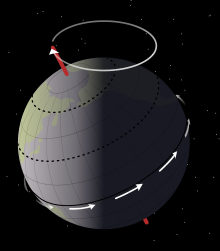
In astronomy, axial precession is a gravity-induced, slow and continuous change in the orientation of an astronomical body's rotational axis. In particular, it refers to the gradual shift in the orientation of Earth's axis of rotation, which, like a wobbling top, traces out a cone in a cycle of approximately 26,000 years (called a Great or Platonic Year in astrology). The term "precession" typically refers only to this largest secular motion; other changes in the alignment of Earth's axis — nutation and polar motion — are much smaller in magnitude.

Earth's precession was historically called precession of the equinoxes because the equinoxes moved westward along the ecliptic relative to the fixed stars, opposite to the motion of the Sun along the ecliptic. This term is still used in non-technical discussions, that is, when detailed mathematics are absent. Historically, Hipparchus is credited with discovering precession of the equinoxes. The exact dates of his life are not known, but astronomical observations attributed to him by Ptolemy date from 147 BC to 127 BC.

With improvements in the ability to calculate the gravitational force between planets during the first half of the 19th century, it was recognized that the ecliptic itself moved slightly, which was named planetary precession as early as 1863, while the dominant component was named lunisolar precession. Their combination was named general precession instead of precession of the equinoxes. Lunisolar precession is caused by the gravitational forces of the Moon and Sun on Earth's equatorial bulge, causing Earth's axis to move with respect to inertial space. Planetary precession (actually an advance) is due to the small angle between the gravitational force of the other planets on Earth and its orbital plane (the ecliptic), causing the plane of the ecliptic to shift slightly relative to inertial space. Lunisolar precession is about 500 times larger than planetary precession. In addition to the Moon and Sun, the other planets also cause a small movement of Earth's axis in inertial space, making the contrast in the terms lunisolar versus planetary misleading, so in 2006 the International Astronomical Union recommended that the dominant component be renamed the precession of the equator and the minor component be renamed precession of the ecliptic, but their combination is still named general precession.

Effects

The precession of the Earth's axis has a number of observable effects. First, the positions of the south and north celestial poles appear to move in circles against the space-fixed backdrop of stars, completing one circuit in 25,771.5 years (2000 rate). Thus, while today the star Polaris lies approximately at the north celestial pole, this will change over time, and other stars will become the "north star". As the celestial poles shift, there is a corresponding gradual shift in the apparent orientation of the whole star field, as viewed from a particular position on Earth.

Secondly, the position of the Earth in its orbit around the Sun at the solstices, equinoxes, or other time defined relative to the seasons, slowly changes. For example, suppose that the Earth's orbital position is marked at the summer solstice, when the Earth's axial tilt is pointing directly towards the Sun. One full orbit later, when the Sun has returned to the same apparent position relative to the background stars, the Earth's axial tilt is not now directly towards the Sun: because of the effects of precession, it is a little way "beyond" this. In other words, the solstice occurred a little earlier in the orbit. Thus, the tropical year, measuring the cycle of seasons (for example, the time from solstice to solstice, or equinox to equinox), is about 20 minutes shorter than the sidereal year, which is measured by the Sun's apparent position relative to the stars. Note that 20 minutes per year is approximately equivalent to one year per 25,771.5 years, so after one full cycle of 25,771.5 years the positions of the seasons relative to the orbit are "back where they started". (In actuality, other effects also slowly change the shape and orientation of the Earth's orbit, and these, in combination with precession, create various cycles of differing periods; see also Milankovitch cycles. The magnitude of the Earth's tilt, as opposed to merely its orientation, also changes slowly over time, but this effect is not attributed directly to precession.)

For identical reasons, the apparent position of the Sun relative to the backdrop of the stars at some seasonally fixed time, say the vernal equinox, slowly regresses a full 360° through all twelve traditional constellations of the zodiac, at the rate of about 50.3 seconds of arc per year (approximately 360 degrees divided by 25,771.5), or 1 degree every 71.6 years.

13 Ocak 2011 Perşembe

Android


Android is a mobile operating system initially developed by Android Inc. Android was bought by Google in 2005. Android is based upon a modified version of the Linux kernel. Google and other members of the Open Handset Alliance collaborated on Android's development and release. The Android Open Source Project (AOSP) is tasked with the maintenance and further development of Android. Unit sales for Android OS smartphones ranked first among all smartphone OS handsets sold in the U.S. in the second and third quarters of 2010, with a third quarter market share of 43.6%.

Android has a large community of developers writing application programs ("apps") that extend the functionality of the devices. There are currently over 200,000 apps available for Android. Android Market is the online app store run by Google, though apps can be downloaded from third party sites (AT&T only permits third party apps on their Aria phone). Developers write primarily in the Java language, controlling the device via Google-developed Java libraries.] Python, Ruby and other languages are also available for Android development via the Android Scripting Environment.

The unveiling of the Android distribution on 5 November 2007 was announced with the founding of the Open Handset Alliance, a consortium of 79 hardware, software, and telecom companies devoted to advancing open standards for mobile devices. Google released most of the Android code under the Apache License, a free software and open source license.

The Android operating system software stack consists of Java applications running on a Java based object oriented application framework on top of Java core libraries running on a Dalvik virtual machine featuring JIT compilation. Libraries written in C include the surface manager, OpenCore media framework, SQLite relational database management system, OpenGL ES 2.0 3D graphics API, WebKit layout engine, SGL graphics engine, SSL, and Bionic libc. The Android operating system consists of 12 million lines of code including 3 million lines of XML, 2.8 million lines of C, 2.1 million lines of Java, and 1.75 million lines of C++.

2.3 (Gingerbread) Based on Linux Kernel 2.6.35.7

Updated user interface design
Support for extra-large screen sizes and resolutions (WXGA and higher)
Native support for SIP VoIP telephony
Support for WebM/VP8 video playback, and AAC audio encoding
New audio effects such as reverb, equalization, headphone virtualization, and bass boost
Support for Near Field Communication
System-wide copy–paste functionalities
Redesigned multi-touch software keyboard
Enhanced support for native code development
Audio, graphical, and input enhancements for game developers
Concurrent garbage collection for increased performance
Native support for more sensors (such as gyroscopes and barometers)
A download manager for long running downloads
Improved power management and application control
Native support for multiple cameras
Switched from YAFFS to the ext4 filesystem

Community-based firmware

There is a community of open-source enthusiasts that build and share Android-based firmware with a number of customizations and additional features, such as FLAC lossless audio support and the ability to store downloaded applications on the microSD card. This usually involves rooting the device. Rooting allows users root access to the operating system, giving more control over their environment variables. In order to use custom firmwares the devices bootloader must be unlocked. Rooting alone does not allow the flashing of custom firmware. Modified firmwares allow users of older phones to use applications available only on newer releases.

Those firmware packages are updated frequently, incorporate elements of Android functionality that haven't yet been officially released within a carrier-sanctioned firmware, and tend to have fewer limitations. CyanogenMod and VillainROM are two examples of such firmware.

On 24 September 2009, Google issued a cease and desist letter to the modder Cyanogen, citing issues with the re-distribution of Google's closed-source applications within the custom firmware. Even though most of Android OS is open source, phones come packaged with closed-source Google applications for functionality such as the application store and GPS navigation. Google has asserted that these applications can only be provided through approved distribution channels by licensed distributors. Cyanogen has complied with Google's wishes and is continuing to distribute this mod without the proprietary software. He has provided a method to back up licensed Google applications during the mod's install process and restore them when it is complete.

1 Ocak 2011 Cumartesi

Plex


Plex (also known as "Plexapp" or "Plex Media Center") is a partially open-source freeware media player for Intel-based Apple Macintosh computers. It has a 10-foot user interface design for the living-room TV. Its source code was initially forked from XBMC Media Center on May 21, 2008 which Plex today uses as an application framework platform for its GUI (Graphical User Interface) and media player part of their software. Similar to XBMC and Boxee, it is an alternative to Apple's Front Row for Mac, with skinnable and user-configurable interface.

Plex integrates content from iTunes and iPhoto (from the iLife software suite) as well as allows the user to manage all video, photos, music, and podcasts from a computer, optical disk, local network, and the Internet using an Apple or Harmony remote control. In 2009 the developers added their own 'app store' digital distribution platform called "Plex Online" with a growing list of community driven plugins for online content like Hulu, Netflix, and CNN video that are being distributed via "Plex Media Server" application which runs as a standa-alone software and media management interface.

Plex began as a free software hobby project but since 2010 has evolved into a (freeware) project that is owned and developed by a single for-profit startup company, (Plex, Inc.). It is a high tech company based in the United States that is responsible for the development of the Plex front-ends and back-end, its client–server model, and all accompanying software under the "Plex" trademark, as well as the exclusive copyright of the closed source software/code parts for both commercial and non-commercial use.

Plex supports a wide range of multimedia formats and includes features such as playlists, audio visualizations, slideshows, weather forecasts reporting, and an expanding array of third-party plugins. As a media center, Plex can play most audio and video file formats, as well as display images from many sources, including CD/DVD-ROM drive, USB flash drives, the Internet, and local area network shares. DVD playback is not yet fully integrated and requires the use of helper applications like Apple's DVD Player.

Through the processing power of modern Mac computer hardware, Plex is able to decode high-definition video up to 1080p. For older Macintosh computers, the software does not however support any hardware accelerated video decoding which means that users require a 2 GHz Intel Core 2 processor to decode the majority of 1080p videos encoded with the H.264 codec. Newer Apple models using Nvidia 9400M/GT320M/GT330M chipsets and Snow Leopard OS 10.6.3 or later does however benefit from H.264 hardware accelerated video decoding meaning that most of the decoding process is offloaded to the GPU.

Through its plugin system, Plex includes features such as YouTube and Apple movie trailer support, SHOUTcast, and more. Most plugin content (such as the Hulu and Netflix) is provided via a separate helper program called Plex Media Server, while some use an integrated Python runtime engine and plugin framework.

Plex Media Server is from closed source (contains proprietary code), however the other parts of Plex media center software are open-sourced and distributed under the GNU General Public License. Plex's open source code is hosted on GitHub. Plex media center and media player source code was initially based upon XBMC Media Center, which it uses as its application framework. The founder of Plex, Elan Feingold, was actually part of the official XBMC development team for a short while, but tension over the rest of XBMC's developers' strict adherence to the GPL and their open-source software mindset was one of the factors that led Elan (Plex founder) to leave the XBMC project and create the Plex fork.

21 Aralık 2010 Salı

GFAJ-1


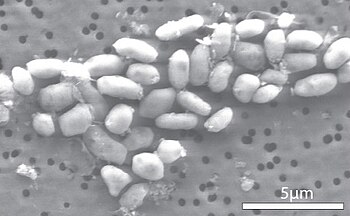
GFAJ-1 is a strain of rod-shaped bacterium in the family Halomonadaceae. The extremophile was isolated from the hypersaline and alkaline Mono Lake in eastern California, and reported as new to science by a research team led by NASA astrobiologist Felisa Wolfe-Simon in a 2010 Science journal publication. According to the authors, the microbe, when starved of phosphorus, is capable of substituting arsenic for a small percentage of its phosphorus and sustain its growth. Immediately after publication, other microbiologists and biochemists expressed doubt about this hypothesis, and the claim that this bacterium uses arsenic instead of phosphorus in its metabolism is robustly debated in the scientific community.


The GFAJ-1 bacterium was discovered by geomicrobiologist Felisa Wolfe-Simon, a NASA astrobiology fellow in residence at the US Geological Survey in Menlo Park, California. GFAJ stands for "Give Felisa a Job". The organism was isolated and cultured beginning in 2009 from samples she and her colleagues collected from sediments at the bottom of Mono Lake, California, U.S.A. Mono Lake is hypersaline (about 90 grams/liter) and highly alkaline (pH 9.8). It also has one of the highest natural concentrations of arsenic in the world (200 μM). The discovery was widely publicized on 2 December 2010.


Biochemistry

A phosphorus-free growth medium (which actually contained 3.1 ± 0.3 μM of residual phosphate, from impurities in reagents) was used to culture the bacteria in a regime of increasing exposure to arsenate; the initial level of 0.1 mM was eventually ramped up to 40 mM. Alternative media used for comparative experiments contained either high levels of phosphate (1.5 mM) with no arsenate, or had neither added phosphate nor added arsenate. It was observed that GFAJ-1 could grow through many doublings in cell numbers when cultured in either phosphate or arsenate media, but could not grow when placed in a medium of a similar composition to which neither phosphate nor arsenate was added. The phosphorus content of the arsenic-fed, phosphorus-starved bacteria (as measured by ICP-MS) was only 0.019 (± 0.001) % by dry weight, one thirtieth of that when grown in phosphate, and about one hundredth that of most bacteria. This phosphorus content was also only about one tenth of the cells' arsenic content (0.19 ± 0.25 % by dry weight). Other data from the same study obtained with nano-SIMS does however suggest a ~75-fold excess of phosphate (P) over arsenic (As) when expressed as P:C and As:C ratios, even in cells grown with arsenate and no added phosphate. When cultured in the arsenate solution, GFAJ-1 only grew 60% as fast as it did in phosphate solution. The phosphate-starved bacteria had an intracellular volume 1.5 times normal; the greater volume appeared to be associated with the appearance of large "vacuole-like regions".

When the researchers added isotope-labeled arsenate to the solution to track its distribution, they found that arsenic was present in the cellular fractions containing the bacteria's proteins, lipids and metabolites such as ATP, as well as its DNA and RNA. Nucleic acids from stationary phase cells starved of phosphorus were concentrated via five extractions (one with phenol, three with phenol-chloroform and one with chloroform extraction solvent), followed by ethanol precipitation. Although direct evidence of the incorporation of arsenic into biomolecules is still lacking, radioactivity measurements suggested that approximately one-tenth (11.0 ± 0.1 %) of the arsenic absorbed by these bacteria ended up in the fraction that contained the nucleic acids (DNA and RNA) and all other co-precipitated compounds not extracted by the previous treatments. A comparable control experiment with isotope-labeled phosphate was not performed.

17 Ekim 2010 Pazar

Nokia E72


The Nokia E72 is a smartphone from the Nokia Eseries range. It is the successor to the Nokia E71 and is based on a similar design and form factor, and offers a similar feature set. The Nokia E72 is an enterprise-based smartphone (as it is a Nokia Eseries device) and has standard features including mobile email, calendar and instant messaging amongst many others.

The Nokia E72 has a new Optical Navi Key feature as opposed to the standard D-pad used on many other Nokia devices including the Nokia E71 - this is said to improve the ease of scrolling through menus, emails, Internet browser, and images as it is an optical sensor rather than a series of closely-spaced buttons. In comparison to its predecessor, the Nokia E72 is said to have a higher level of performance (likely due to the faster 600 MHz ARM processor) and also includes a 5 Megapixel AF camera. Other changes and improvements are software-based including changes to the user interface and built-in messaging application amongst others.

The Nokia E72 was announced on June 15, 2009 at the Nokia Connections 2009 event in Singapore.

The Nokia E73 Mode is a USA version of the E72 for T-Mobile USA, with support for T-Mobile's UMA service and Band IV support for 3G.

Features and enhancements from E7
New features


* Symbian OS 9.3, Series 60 v3.2 UI, Feature Pack 2.
* Optical navi key, along with the conventional D-Pad
* 3.5 mm audio jack
* Ovi Maps with free lifetime drive and walk voice assisted navigation
* Use of front facing camera (video call, VGA snapshots and QCIF videos for 15 seconds)
* USB charging
* Active noise cancellation
* Magnetometer sensor
* Digital compass
* RDS support
* PictBridge
* uPnP Media Streaming support (Not present on E73)
* UMA (E73)

Upgrades

* 3.5mm jack in contrast to the 2.5mm jack used in the E71.
* 12 hours of talktime(2G) instead of the E71's 10hrs (2G).
* Tri-band UMTS / HSDPA / HSUPA instead of Dual-band
* HSDPA support of up to 10.2 Mbit/s instead of 3.6
* Added HSUPA at 2.0 Mbit/s
* Improved CPU clock speed from 369 MHz to 600 MHz
* Real time Push e-mail HTML
* Improved reception from the E71's fluctuating signal reception
* 5 Megapixel camera (up from 3.2)
* VGA at 15 FPS (E72) rather than QVGA at 15 FPS (E71)
* Added flashlight feature


Specs

Available November 2009
Screen 320×240 px, 2.36 in, up to 16.7 million colours
Camera 5 megapixel (2592 x 1944 pixels) with autofocus and LED flash
Second camera Front facing
Operating system S60 3rd Edition Feature Pack 2 UI on Symbian OS v9.3
Input QWERTY thumb keyboard, optical navigation key
CPU 600 MHz ARM11 processor
Memory 250 MB Internal user storage
ROM: 512 MB
SDRAM: 128 MB ~71 MB Free Executable RAM
Memory card MicroSDHC Hot-swappable, support for up to 16GB
Networks
GSM 800 / 900 / 1800 / 1900 MHz
Tri Band UTMS / HSPDA / HSUPA / 850 / 1900 / 2100 MHz (North American Version)
Connectivity WLAN Wi-Fi 802.11 b,g, Integrated & Assisted GPS, Bluetooth 2.0, microUSB, 3.5 mm audio jack
Battery BP-4L, 3.7V 1,500 mAh lithium-polymer
Physical size114 x 59.5 x 10.1 mm
Weight 128 g (with battery)

Other
FOTA (Firmware update Over The Air)
Accelerometer Sensor
Ambient Light Sensor
Magnetometer Sensor
Digital Compass

2 Ekim 2010 Cumartesi

Laughing Man

"The Laughing Man" is a short story written by J. D. Salinger and originally published in The New Yorker magazine on March 19, 1949. It largely takes the structure of a story within a story and is thematically occupied with the relationship between narrative and narrator, and the end of youth. The story also appears in Salinger's short story collection Nine Stories.


The Laughing Man (笑い男, Warai Otoko?) is a fictional hacker character in the anime series Ghost in the Shell: Stand Alone Complex:

History

The hacker's first appearance in the GITS: SAC storyline is six years before the anime starts, when he assaulted the head of Serano Genomics in public on February 3, 2024, hiding his face from eyewitnesses and cameras with his Laughing Man logo. The Laughing Man is such an expert that he can "steal eyes" of entire crowds, in real time—hacking their visual cyber-brain implants, either to make himself appear invisible or to hide his face with the cartoon logo. He can also alter memories, erasing all records of his existence. Many of those who indeed saw his face would only recall and refer to the stylized logo as depicted above. Togusa was one such person, as were many of the witnesses of the initial incident involving the head of Serano Genomics. His talents were recognized even by Motoko Kusanagi and Aramaki. When Section 9 finally tracked him down, they offered him a position on the Section 9 payroll; The Laughing Man was flattered by the offer but politely declined it.

The Laughing Man has quite a fascination with The Catcher in the Rye, as if the work greatly influenced him: like that novel's main character, Holden Caulfield, he can't stand "phonies" (corrupt politicians in this case). He also kept a prized left-handed baseball catcher's mitt for a time with a quote from The Catcher in the Rye written on it: "You know what I'd like to be? I mean, if I had my goddamn choice, I'd just be a catcher in the rye and all". Ironically, while the mitt is actually real, the term "a lefty's catcher mitt" is described in an episode as being net jargon for "something people think exists, but really doesn't." Aoi also has stated fairly out front that he is an atheist (or is, at the very least, completely comfortable with using blasphemous statements such as directly insulting God).

For an unknown amount of time before the storyline begins, the Laughing Man lived in the Ministry of Health, Labour and Welfare's Rehabilitation Center, posing as, not-coincidentally, a deaf-mute in a wheelchair. He apparently revealed his ability to walk and talk to the other patients at the center, who knew him as "leader" ("chief" in the English dub) and referred to his occasional periods of communication as "visits." When Togusa comes to investigate the center, he discovers that someone has written the famous Laughing Man logo text in a PBX cabinet but has added "or should I?" Apparently feeling that he was about to be discovered, the Laughing Man erases all record of his existence from the center, including wiping the memories of his friends (who apparently not only consent to this treatment, but seem to expect it as if they know of it happening before) and vanishes again before Section 9 can track him down.

The Laughing Man has made it a point that he never came up with the name "The Laughing Man" for himself, it was a label that the media gave based on the J.D. Salinger quote on the logo that eventually stuck.


The Laughing Man's kidnapping of the head of Serano Genomics was actually a spontaneous act, and he did not strike again until some six years later. However, following the kidnapping there was, for some time, a large wave of "Laughing Man"-related graffiti attacks, corporate vandalism and extortion. It was later revealed that a corrupt power cabal in the Japanese government used the sudden appearance of the Laughing Man to their own advantage by carrying out acts of corporate sabotage, then heavily using the "Laughing Man" motif in order to fool the media into thinking it was the Laughing Man's doing, thus shifting suspicion from themselves and their illegal actions.

An unexpected element was that 39 people who were arrested in regard to the assassination attempt on Secretary General Daido all showed no sign of external influence by The Laughing Man, or anyone else. It was thought that many of the direct attackers were not influenced at all; they attempted the assassination to be a part of The Laughing Man's effort for the truth. The police, however, informed the public that they were forced to do it through ghost hacking.

"The Laughing Man" became something of a pop culture obsession. Much to the chagrin of the actual Laughing Man - the irony being that since everybody used his icon and name for their own purposes, the original meaning of his actions, an artful forced confession of the truth through fear in the public eye, became "phony" itself. The effort to stand for and demand the truth was also lost forever. A further irony is that the Laughing Man icon itself is a retooling by the Laughing Man of the fictional Starchild Coffee company logo (itself a reference to the Starbucks logo) and the Sunflower Society logo.

The Laughing Man admitted that he embarked on his notorious kidnapping caper after chancing upon a file in the depths of the Net detailing the extensive corruption in the corporate world, leaving the true identity of the propagator of the aforementioned incidents a mystery. The identified Laughing Man confesses to have been a brash student at the time, but had mellowed out somewhat over the six years since the Serano Genomics event, seeming to now prefer a more intellectual approach over his former overzealous and radical approach. His real name, as far as can be ascertained from the number of events where he appears, is Aoi, meaning Blue in Japanese.

After the events of the Section 9 raid by the Umibozu and the last meeting with Motoko and Aramaki, it was discovered that Aoi, though responsible for the initial incident that made the Laughing Man a phenomenon, was not in fact its true originator. He chose to confront Serano only because of the file he found, and despite years of extensive investigation on his own part, he never discovered the origin of that file. It could be said that whoever abandoned the file was in fact the "real" Laughing Man - and it is possible that he obtained it from someone else. Aoi tells Aramaki to make of that what he will.

Aramaki understands the sheer absurdity of it all, but is still impressed enough with Aoi's skills to offer him a position with Section 9. Though Aoi is deeply flattered by the offer, he declined. Afterwards, he disappeared again for the last time from Japanese society; he is probably employed as a librarian in the National Library. Earlier in the series when trying to crack the Laughing Man case, Togusa theorizes that because the Laughing Man was such a superb hacker, he placed no value at all in digital media because it could easily be overwritten or deleted. This would explain Aoi's choice to work in a library, because paper media, existing in a real, physical state, cannot be so easily gotten rid of or altered.