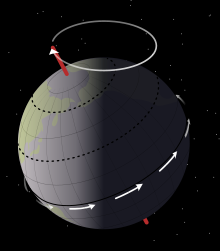
In astronomy, axial precession is a gravity-induced, slow and continuous change in the orientation of an astronomical body's rotational axis. In particular, it refers to the gradual shift in the orientation of Earth's axis of rotation, which, like a wobbling top, traces out a cone in a cycle of approximately 26,000 years (called a Great or Platonic Year in astrology). The term "precession" typically refers only to this largest secular motion; other changes in the alignment of Earth's axis — nutation and polar motion — are much smaller in magnitude.
Earth's precession was historically called precession of the equinoxes because the equinoxes moved westward along the ecliptic relative to the fixed stars, opposite to the motion of the Sun along the ecliptic. This term is still used in non-technical discussions, that is, when detailed mathematics are absent. Historically, Hipparchus is credited with discovering precession of the equinoxes. The exact dates of his life are not known, but astronomical observations attributed to him by Ptolemy date from 147 BC to 127 BC.
With improvements in the ability to calculate the gravitational force between planets during the first half of the 19th century, it was recognized that the ecliptic itself moved slightly, which was named planetary precession as early as 1863, while the dominant component was named lunisolar precession. Their combination was named general precession instead of precession of the equinoxes. Lunisolar precession is caused by the gravitational forces of the Moon and Sun on Earth's equatorial bulge, causing Earth's axis to move with respect to inertial space. Planetary precession (actually an advance) is due to the small angle between the gravitational force of the other planets on Earth and its orbital plane (the ecliptic), causing the plane of the ecliptic to shift slightly relative to inertial space. Lunisolar precession is about 500 times larger than planetary precession. In addition to the Moon and Sun, the other planets also cause a small movement of Earth's axis in inertial space, making the contrast in the terms lunisolar versus planetary misleading, so in 2006 the International Astronomical Union recommended that the dominant component be renamed the precession of the equator and the minor component be renamed precession of the ecliptic, but their combination is still named general precession.
Effects
The precession of the Earth's axis has a number of observable effects. First, the positions of the south and north celestial poles appear to move in circles against the space-fixed backdrop of stars, completing one circuit in 25,771.5 years (2000 rate). Thus, while today the star Polaris lies approximately at the north celestial pole, this will change over time, and other stars will become the "north star". As the celestial poles shift, there is a corresponding gradual shift in the apparent orientation of the whole star field, as viewed from a particular position on Earth.
Secondly, the position of the Earth in its orbit around the Sun at the solstices, equinoxes, or other time defined relative to the seasons, slowly changes. For example, suppose that the Earth's orbital position is marked at the summer solstice, when the Earth's axial tilt is pointing directly towards the Sun. One full orbit later, when the Sun has returned to the same apparent position relative to the background stars, the Earth's axial tilt is not now directly towards the Sun: because of the effects of precession, it is a little way "beyond" this. In other words, the solstice occurred a little earlier in the orbit. Thus, the tropical year, measuring the cycle of seasons (for example, the time from solstice to solstice, or equinox to equinox), is about 20 minutes shorter than the sidereal year, which is measured by the Sun's apparent position relative to the stars. Note that 20 minutes per year is approximately equivalent to one year per 25,771.5 years, so after one full cycle of 25,771.5 years the positions of the seasons relative to the orbit are "back where they started". (In actuality, other effects also slowly change the shape and orientation of the Earth's orbit, and these, in combination with precession, create various cycles of differing periods; see also Milankovitch cycles. The magnitude of the Earth's tilt, as opposed to merely its orientation, also changes slowly over time, but this effect is not attributed directly to precession.)
For identical reasons, the apparent position of the Sun relative to the backdrop of the stars at some seasonally fixed time, say the vernal equinox, slowly regresses a full 360° through all twelve traditional constellations of the zodiac, at the rate of about 50.3 seconds of arc per year (approximately 360 degrees divided by 25,771.5), or 1 degree every 71.6 years.