
SGI Irix
Irix History by Ryan Thoryk
IRIX is a computer operating system developed by Silicon Graphics, Inc. (SGI) to run natively on their 32- and 64-bit MIPS architecture workstations and servers. Based on UNIX System V with BSD extensions.
The current major version of IRIX is IRIX 6.5 which was released in May 1998. New minor versions are released every quarter. Through version 6.5.22, there were two branches of each release: a maintenance release that included only fixes to the original IRIX 6.5 code, and a feature release that included improvements and enhancements. An overlay upgrade from 6.5.x to the 6.5.22 maintenance release is available for free download, while version 6.5.23 and higher require an active Silicon Graphics support contract, despite only running on Silicon Graphics hardware.


The IRIX name was first used around the time of release 3.0 of the operating system for SGI's IRIS 4D series of workstations and servers, in 1988. Previous releases were identified only by the release number prefixed by "4D1-", eg. "4D1-2.2". The 4D1- prefix continued to be used in official documentation to prefix IRIX release numbers.


IRIX 3.x was based on UNIX System V Release 3 with 4.3BSD enhancements, and incorporated the 4Sight windowing system, based on NeWS and IRIS GL. SGI's own Extent File System (EFS) replaced the System V filesystem.
IRIX 4.0, released in 1991, replaced 4Sight with the X Window System (X11R4), the 4Dwm window manager providing a similar look and feel to 4Sight.
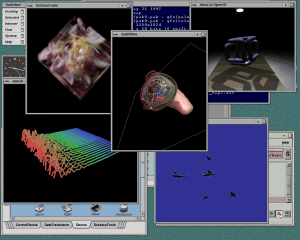
IRIX 5.0, released in 1993, incorporated certain features of UNIX System V Release 4, including ELF-format executables. IRIX 5.3 introduced the XFS journaling file system.
In 1994, IRIX 6.0 added support for the 64-bit MIPS R8000 processor, but was otherwise similar to IRIX 5.2. Later 6.x releases supported other members of the MIPS processor family in 64-bit mode. IRIX 6.3 was released for desktop systems only. IRIX 6.4 improved multiprocessor scalability for the Origin 2000 and Onyx2 systems and was marketed as "Cellular IRIX", although it only incorporated some features from the original Cellular IRIX distributed operating system project. IRIX 6.4 had severe reliability issues, limiting its adoption. IRIX development stabilized with IRIX 6.5, released in 1998. The current version of IRIX is 6.5.30, released in August 2006.


IRIX 6 is compliant with UNIX System V Release 4, UNIX 95 and POSIX (including 1e/2c draft 15 ACLs and Capabilities).
IRIX has strong support for real-time disk and graphics I/O. IRIX was one of the first Unix versions to feature a graphical user interface for the main desktop environment. IRIX was widely used in the computer animation industry and for scientific visualization due to its once-large application base.


IRIX uses the Indigo Magic Desktop, which by default uses the 4Dwm X window manager with a custom look designed using the Motif widget toolkit.

