nsa etiketine sahip kayıtlar gösteriliyor. Tüm kayıtları göster

25 Aralık 2007 Salı

Advanced Encryption Standard


AES

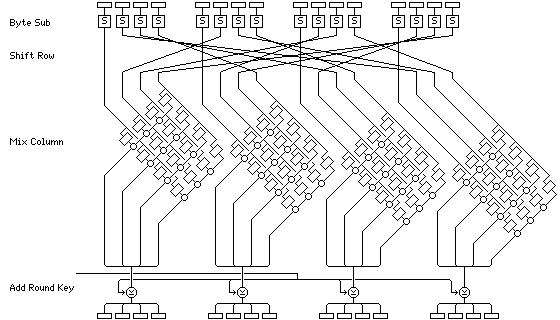
In cryptography, the Advanced Encryption Standard (AES), also known as Rijndael, is a block cipher adopted as an encryption standard by the U.S. government. It has been analyzed extensively and is now used widely worldwide as was the case with its predecessor, the Data Encryption Standard (DES). AES was announced by National Institute of Standards and Technology (NIST) as U.S. FIPS PUB 197 (FIPS 197) on November 26, 2001 after a 5-year standardization process (see Advanced Encryption Standard process for more details). It became effective as a standard May 26, 2002. As of 2006, AES is one of the most popular algorithms used in symmetric key cryptography. It is available by choice in many different encryption packages.

The cipher was developed by two Belgian cryptographers, Joan Daemen and Vincent Rijmen, and submitted to the AES selection process under the name "Rijndael", a portmanteau of the names of the inventors.

As of 2006, the only successful attacks against AES have been side channel attacks. The National Security Agency (NSA) reviewed all the AES finalists, including Rijndael, and stated that all of them were secure enough for US Government non-classified data. In June 2003, the US Government announced that AES may be used for classified information:

"The design and strength of all key lengths of the AES algorithm (i.e., 128, 192 and 256) are sufficient to protect classified information up to the SECRET level. TOP SECRET information will require use of either the 192 or 256 key lengths. The implementation of AES in products intended to protect national security systems and/or information must be reviewed and certified by NSA prior to their acquisition and use."

This marks the first time that the public has had access to a cipher approved by NSA for encryption of TOP SECRET information. Many public products use 128-bit secret keys by default; it is possible that NSA suspects a fundamental weakness in keys this short, or they may simply prefer a safety margin for top secret documents (which may require security decades into the future).

18 Ekim 2007 Perşembe

Sectéra Edge


Secure Mobile Environment Portable Electronic Device (SME PED)

General Dynamics C4 Systems Sectéra Edge

General Dynamics C4 Systems recently delivered 60 Sectera Edge engineering models to the U.S. Government for evaluation under the NSA's Secure Mobile Environment Personal Electronic Device (SME PED) contract. The secure mobile telephone and personal digital assistant brings security to the tactical edge, enabling classified and unclassified voice conversations and data communications in a ruggedized handheld device. Capabilities include e-mail, web access, and file viewing via commercial wireless networks as well secure wireless access to the U.S. Government Secret Internet Protocol Router Network (SIPRNet) and Unclassified but Sensitive Internet Protocol Router Network (NIPRNet). The Sectrra Edge is the critical next-step to providing a robust and secure link to next generation battlefield communication networks with scalability to support homeland security and coalition government requirements.

o Secure and non-secure wireless phone, e-mail and web browsing
o Withstands rigors of both tactical and everyday environments
o Global roaming over GSM, CDMA or Wi-Fi wireless networks
o Software upgradeable to VoIP
o Exchange secure e-mail with government personnel, including S/MIME BlackBerry users
o IPv6 software upgradeable
o Familiar Microsoft® Windows® Platform
o Wired and wireless desktop synchronization
o Separation of Classified and Unclassified applications
o Switch between classified and unclassified PDA with a single keystroke
o Secure wireless access to the SIPRNET and NIPRNET
o DoD PKI enabled Common Access Card (CAC) support
o Supports DoD 8100.2 requirements
o Type 1 encrypted storage of classified data
o Can be used inside closed areas with “SCIF-Friendly” mode

13 Ağustos 2007 Pazartesi

The SHA Hash Functions

SHA1search.com

RSA Wikipedia

Electronic Frontier Foundation

The SHA hash functions are five cryptographic hash functions designed by the National Security Agency (NSA) and published by the NIST as a U.S. Federal Information Processing Standard. SHA stands for Secure Hash Algorithm. Hash algorithms compute a fixed-length digital representation (known as a message digest) of an input data sequence (the message) of any length. They are called “secure” when (in the words of the standard), “it is computationally infeasible to:

   1. find a message that corresponds to a given message digest, or
   2. find two different messages that produce the same message digest.

Any change to a message will, with a very high probability, result in a different message digest.”

The five algorithms are denoted SHA-1, SHA-224, SHA-256, SHA-384, and SHA-512. The latter four variants are sometimes collectively referred to as SHA-2. SHA-1 produces a message digest that is 160 bits long; the number in the other four algorithms' names denote the bit length of the digest they produce.

SHA-1 is employed in several widely used security applications and protocols, including TLS and SSL, PGP, SSH, S/MIME, and IPsec. It was considered to be the successor to MD5, an earlier, widely-used hash function.

The security of SHA-1 has been somewhat compromised by cryptography researchers. Although no attacks have yet been reported on the SHA-2 variants, they are algorithmically similar to SHA-1 and so efforts are underway to develop improved alternative hashing algorithms. "NIST is initiating an effort to develop one or more additional hash algorithms through a public competition, similar to the development process for the Advanced Encryption Standard (AES)." It's tentatively scheduled to proclaim winner and publish final standard in 2012.

Even a small change in the message will, with overwhelming probability, result in a completely different hash due to the avalanche effect.

SHA1("The quick brown fox jumps over the lazy dog")
  = 2fd4e1c6 7a2d28fc ed849ee1 bb76e739 1b93eb12

SHA1("The quick brown fox jumps over the lazy cog")
  = de9f2c7f d25e1b3a fad3e85a 0bd17d9b 100db4b3