5 Temmuz 2012 Perşembe

Higgs Boson


The Higgs boson is a hypothetical particle, a boson, that is the quantum of the Higgs field. The field and the particle provide a testable hypothesis for the origin of mass in elementary particles. In popular culture, the Higgs boson is also called the God particle, after the title of Nobel physicist Leon Lederman’s The God Particle: If the Universe Is the Answer, What Is the Question? (1993), which contained the author’s assertion that the discovery of the particle is crucial to a final understanding of the structure of matter.


The existence of the Higgs boson was predicted in 1964 to explain the Higgs mechanism—the mechanism by which elementary particles are given mass. While the Higgs mechanism is considered confirmed to exist, the boson itself—a cornerstone of the leading theory—had not been observed and its existence was unconfirmed. Its tentative discovery in 2012 may validate the Standard Model as essentially correct, as it is the final elementary particle predicted and required by the Standard Model which has not yet been observed via particle physics experiments. Alternative sources of the Higgs mechanism that do not need the Higgs boson also are possible and would be considered if the existence of the Higgs boson were to be ruled out. They are known as Higgsless models.
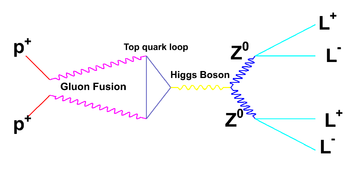


The Higgs boson is named after Peter Higgs, who was one of six authors in the 1960s who wrote the ground-breaking papers covering what is now known as the Higgs mechanism and described the related Higgs Field and boson. Technically, it is the quantum excitation of the Higgs field, and the non-zero value of the ground state of this field gives mass to the other elementary particles such as quarks and electrons through the Higgs mechanism. The Standard Model completely fixes the properties of the Higgs boson, except for its mass. It is expected to have no spin and no electric or color charge, and it interacts with other particles through the weak interaction and Yukawa-type interactions between the various fermions and the Higgs field.
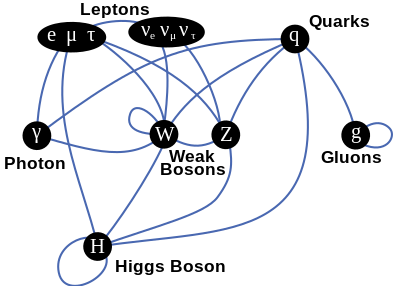


Because the Higgs boson is a very massive particle and decays almost immediately when created, only a very high energy particle accelerator can observe and record it. Experiments to confirm and determine the nature of the Higgs boson using the Large Hadron Collider (LHC) at CERN began in early 2010, and were performed at Fermilab's Tevatron until its close in late 2011. Mathematical consistency of the Standard Model requires that any mechanism capable of generating the masses of elementary particles become visible at energies above 1.4 TeV; therefore, the LHC (designed to collide two 7 TeV proton beams, but currently running at 4 TeV each) was built to answer the question of whether or not the Higgs boson exists.


On 4 July 2012, the two main experiments at the LHC (ATLAS and CMS) both reported independently the confirmed existence of a previously unknown particle with a mass of about 125 GeV/c2 (about 133 proton masses, on the order of 10-25 kg), which is "consistent with the Higgs boson" and widely believed to be the Higgs boson. They acknowledged that further work would be needed to confirm that it is indeed the Higgs boson and not some other previously unknown particle (meaning that it has the theoretically predicted properties of the Higgs boson) and, if so, to determine which version of the Standard Model it best supports.


Overview

In particle physics, elementary particles and forces give rise to the world around us. Physicists explain the behaviors of these particles and how they interact using the Standard Model—a widely accepted framework believed to explain most of the world we see around us. Initially, when these models were being developed and tested, it seemed that the mathematics behind those models, which were satisfactory in areas already tested, would also forbid elementary particles from having any mass, which showed clearly that these initial models were incomplete. In 1964 three groups of physicists almost simultaneously released papers describing how masses could be given to these particles, using approaches known as symmetry breaking. This approach allowed the particles to obtain a mass, without breaking other parts of particle physics theory that were already believed reasonably correct. This idea became known as the Higgs Mechanism (not the same as the boson), and later experiments confirmed that such a mechanism does happen—but they could not show exactly how it happens.

The leading and simplest theory for how this effect takes place in nature was that if a particular kind of "field" (known as a Higgs Field) happened to permeate space, and if it could interact with fundamental particles in a particular way, then this would give rise to a Higgs Mechanism in nature, and would therefore create around us the phenomenon we call "mass". During the 1960s and 1970s the Standard Model of physics was developed on this basis, and it included a prediction and requirement that for these things to be true, there had to be an undiscovered boson—one of the fundamental particles—as the counterpart of this field. This would be the Higgs boson. If the Higgs boson was confirmed to exist, as the Standard Model suggested, then scientists could be satisfied that the Standard Model was fundamentally correct. If the Higgs boson was confirmed as not existing, then other theories would be considered as candidates instead.

The Standard Model also made clear that the Higgs boson would be very difficult to demonstrate. It exists for only a tiny fraction of a second before breaking up into other particles—so quickly that it cannot be directly detected—and can be detected only by identifying the results of its immediate decay and analyzing them to show they were probably created by a Higgs boson and not some other reason. The Higgs boson requires so much energy to create (compared to many other fundamental particles) that it also requires a massive particle accelerator to create collisions energetic enough to create it and record the traces of its decay. Given a suitable accelerator and appropriate detectors, scientists can record trillions of particles colliding, analyze the data for collisions likely to be a Higgs boson, and then perform further analysis to test how likely it is that the results combined show a Higgs boson does exist, and that the results are not just due to chance.

Experiments to try and show whether the Higgs boson did or did not exist began in the 1980s, but until the 2000s it could only be said that certain areas were plausible, or ruled out. In 2008 the Large Hadron Collider (LHC) was inaugurated, being the most powerful particle accelerator ever built. It was designed especially for this experiment, and other very high energy tests of the Standard Model. In 2010 it began its primary research role which was to prove whether or not the Higgs boson existed.

In late 2011 two of the LHC's experiments independently began to suggest "hints" of a Higgs boson detection around 125 GeV (the unit of particle mass). In July 2012 CERN announced[1] evidence of discovery of a boson with an energy level and other properties consistent with those expected in a Higgs boson. The available data raised a high statistical likelihood that the Higgs boson had been detected. Further work is necessary for the evidence to be considered conclusive (or disproved). If the newly discovered particle is indeed the Higgs boson, attention will turn to considering whether its characteristics match one of the extant versions of the Standard Model. The CERN data include clues that the additional bosons or similar-mass particles may have been discovered as well as, or instead of, the Higgs itself. If a different boson were confirmed, it would allow and require the development of new theories to supplant the current Standard Model.

Peter Higgs


Peter Ware Higgs, FRS, FRSE, FKC (born 29 May 1929) is a British theoretical physicist and emeritus professor at the University of Edinburgh. He is best known for his 1960s proposal of broken symmetry in electroweak theory, explaining the origin of mass of elementary particles in general and of the W and Z bosons in particular. This so-called Higgs mechanism, which was proposed by several physicists besides Higgs at about the same time, predicts the existence of a new particle, the Higgs boson (often described as "the most sought-after particle in modern physics"). CERN announced on 4 July 2012 that they had experimentally established the existence of a Higgs-like boson, but further work is needed to analyse its properties and see if it has the properties expected from the Standard Model Higgs boson. The Higgs mechanism is generally accepted as an important ingredient in the Standard Model of particle physics, without which particles would have no mass. Higgs has been honoured with a number of awards in recognition of his work, including the 1997 Dirac Medal and Prize for outstanding contributions to theoretical physics from the Institute of Physics, the 1997 High Energy and Particle Physics Prize by the European Physical Society, the 2004 Wolf Prize in Physics, and the 2010 J. J. Sakurai Prize for Theoretical Particle Physics.


July 04th, 2012

12 Mart 2012 Pazartesi

NIST hash function competition SHA-3

NIST SHA3

The NIST hash function competition is an open competition held by the US National Institute of Standards and Technology for a new SHA-3 function to replace the older SHA-1 and SHA-2, which was formally announced in the Federal Register on November 2, 2007. "NIST is initiating an effort to develop one or more additional hash algorithms through a public competition, similar to the development process for the Advanced Encryption Standard (AES)."

Submissions were due October 31, 2008, with a list of candidates accepted for the first round published December 9, 2008. NIST held a conference in late February 2009 where submitters gave presentations on their algorithms and NIST officials discussed criteria for narrowing down the field of candidates for Round 2. The list of 14 candidates accepted to Round 2 was published on July 24, 2009. Another conference was held August 23-24, 2010 (after CRYPTO 2010) at the University of California, Santa Barbara, where the second-round candidates were discussed. The announcement of the final round candidates occurred on December 10, 2010 and the proclamation of a winner and publication of the new standard are scheduled to take place in 2012.

Finalists

NIST has selected five SHA-3 candidate algorithms to advance to the third (and final) round:
BLAK
Grøstl (Knudsen et al.)
JH
Keccak (Keccak team, Daemen et al.)
Skein (Schneier et al.)


NIST noted some factors that figured into its selection as it announced the finalists:

Performance: "A couple of algorithms were wounded or eliminated by very large [hardware gate] area requirement – it seemed that the area they required precluded their use in too much of the potential application space."

Security: "We preferred to be conservative about security, and in some cases did not select algorithms with exceptional performance, largely because something about them made us 'nervous,' even though we knew of no clear attack against the full algorithm."

Analysis: "NIST eliminated several algorithms because of the extent of their second-round tweaks or because of a relative lack of reported cryptanalysis – either tended to create the suspicion that the design might not yet be fully tested and mature."

Diversity: The finalists included hashes based on different modes of operation, including the HAIFA and sponge hash constructions, and with different internal structures, including ones based on AES, bitslicing, and alternating XOR with addition.

NIST has released a report explaining its evaluation algorithm-by-algorithm.

Meltem Sönmez Turan's Blog

29 Eylül 2011 Perşembe

Demon Core


The Demon core was the nickname given to a 6.2-kilogram (14 lb) subcritical mass of plutonium that accidentally went briefly critical in two separate accidents at the Los Alamos laboratory in 1945 and 1946. Both incidents resulted in the acute radiation poisoning and the subsequent death of a scientist. After these incidents, the sphere of plutonium was referred to as the Demon Core.

The core was used in an atomic bomb test in 1946, five weeks after the second fatal accident, and proved in practice to have a slightly increased yield over similar cores which had not been subjected to criticality excursions.

First incident

On August 21, 1945, the plutonium core produced a burst of neutron radiation that caught Harry Daghlian in its path. Daghlian was a physicist who made a mistake while working alone performing neutron reflection experiments on the core. The core was placed within a stack of neutron-reflective tungsten carbide bricks, and the addition of each brick moved the assembly closer to criticality. While attempting to stack another brick around the assembly Daghlian accidentally dropped it onto the core and thereby caused the core to go critical. Despite quick action in moving the brick off the assembly, Daghlian received a fatal dose of radiation. He died 25 days later from acute radiation poisoning.

Another person who was in the lab at the time of the accident—Private Robert J. Hemmerly, a Special Engineer Detachment (SED) guard—received an exposure of approximately 31 roentgens of soft X-rays (80 kV equivalent) and less than 1 roentgen of gamma rays. Hemmerly died in 1978 (33 years after the accident) from acute myelogenous leukemia at the age of 62.

Second Incident

On May 21, 1946, physicist Louis Slotin and seven other scientists were in a Los Alamos laboratory conducting an experiment to verify the exact point at which a subcritical mass (core) of fissile material could be made critical by the positioning of neutron reflectors. The test was known as "tickling the dragon's tail" for its extreme risk. It required the operator to place two half-spheres of beryllium (a neutron reflector) around the core to be tested and manually lower the top reflector over the core via a thumb hole on the top. As the reflectors were manually moved closer and farther away from each other, scintillation counters measured the relative activity from the core. Allowing them to close completely would result in the instantaneous formation of a critical mass and a lethal power excursion. Under Slotin's unapproved protocol, the only thing preventing this was the blade of a standard flathead screwdriver, manipulated by the scientist's other hand. Slotin, who was given to bravado, became the local expert, performing the test almost a dozen separate times, often in his trademark bluejeans and cowboy boots, in front of a roomful of observers. Enrico Fermi reportedly told Slotin and others they would be "dead within a year" if they continued performing it.

While lowering the top reflector, Slotin's screwdriver slipped a fraction of an inch, allowing the top reflector to fall into place around the core. Instantly there was a flash of blue light and a wave of heat across Slotin's skin; the core had become supercritical, releasing a massive burst of neutron radiation. He quickly knocked the two halves apart, stopping the chain reaction and likely saving the lives of the other men in the laboratory. Slotin's body positioning over the apparatus also shielded the others from much of the neutron radiation. He received a massively lethal dose in under a second and died nine days later from acute radiation poisoning. The nearest physicist to Slotin, Alvin C. Graves, was watching over Slotin's shoulder and was thus partially shielded by him, receiving a high but non-lethal radiation dose. Graves was hospitalized for several weeks with severe radiation poisoning, developed chronic neurological and vision problems as a result of the exposure, suffered a significant shortening of his lifespan and died of a radiation-induced heart attack 20 years later. The other six people in the room were far enough away from the assembly to avoid fatal injury, but they all suffered other complications as a result of the accident. Two people suffered severe shortening of their lives and died years later from radiation induced complications: leukemia (at age 42, 18 years after the accident) and clinical aplastic anemia.

Demon Core In Use

The Demon core was put to use for the Able detonation test of the Crossroads series on July 1, 1946, demonstrating that the criticality experiments of Daghlian and Slotin increased the efficiency of the weapon.

1 Temmuz 2011 Cuma

Dark Flow

Dark flow is an astrophysical term describing a peculiar velocity of galaxy clusters. The actual measured velocity is the sum of the velocity predicted by Hubble's Law plus a small and unexplained (or dark) velocity flowing in a common direction.

According to standard cosmological models, the motion of galaxy clusters with respect to the cosmic microwave background should be randomly distributed in all directions. However, analyzing the three-year WMAP data using the kinematic Sunyaev-Zel'dovich effect, the authors of the study found evidence of a "surprisingly coherent" 600–1000 km/s flow of clusters toward a 20-degree patch of sky between the constellations of Centaurus and Vela.

The authors (Alexander Kashlinsky, F. Atrio-Barandela, D. Kocevski, and H. Ebeling) suggest that the motion may be a remnant of the influence of no-longer-visible regions of the universe prior to inflation. Telescopes cannot see events earlier than about 380,000 years after the big bang, when the universe became transparent (the Cosmic Microwave Background); this corresponds to the particle horizon at a distance of about 46 billion (4.6×10^10) light years. Since the matter causing the net motion in this proposal is outside this range, it would in a certain sense be outside our visible universe; however, it would still be in our past light cone.

The results appeared in the October 20, 2008, issue of Astrophysical Journal Letters. Since then, the authors have extended their analysis to additional clusters and the recently released WMAP five-year data.

Location

The dark flow was determined to be flowing in the direction of the Centaurus and Hydra constellations. This corresponds with the direction of the Great Attractor, which was a previous gravitational mystery originally discovered in 1973. However, the source of the Great Attractor's attraction was thought to originate from a massive cluster of galaxies called the Norma cluster, situated merely between 150-250 million light-years away. This may reveal that the source of that attraction might lie even further away, and which the Great Attractor itself is heading towards.

In a study from March 2010, Kashlinsky extended his work from 2008, by using the 5-year WMAP results rather than the 3-year results, and doubling the number of galaxy clusters observed from 700. The team also sorted the cluster catalog into four "slices" representing different distance ranges. They then examined the preferred flow direction for the clusters within each slice. While the size and exact position of this direction display some variation, the overall trends among the slices exhibit remarkable agreement. "We detect motion along this axis, but right now our data cannot state as strongly as we'd like whether the clusters are coming or going," Kashlinsky said.

The team has so far catalogued the effect as far out as 2.5 billion light-years, and hope to expand their catalog out further still to twice the current distance.


Panoramic view of galaxies beyond Milky Way, with Norma cluster & Great Attractor shown by a long blue arrow at the bottom-right in image near the disk of the Milky Way.


NASA's Goddard Space Center confirmed this could be the effects of a sibling universe or a region of space-time fundamentally different from the observable universe. Data on more than 1,000 galaxy clusters have been measured, including some as distant as 3 billion light-years. Alexander Kashlinsky claims these measurements show the universe's steady flow is clearly not a statistical fluke. Said Kashlinsky: "At this point we don't have enough information to see what it is, or to constrain it. We can only say with certainty that somewhere very far away the world is very different than what we see locally. Whether it's 'another universe' or a different fabric of space-time we don't know."

Sloan Great Wall


The Sloan Great Wall is a giant wall of galaxies (a galactic filament) and to the present day is the largest known structure in the universe. Its discovery was announced on October 20, 2003 by J. Richard Gott III of Princeton University and Mario Jurić and their colleagues, based on data from the Sloan Digital Sky Survey.

The wall measures 1.37 billion light years (1.30×1025 m) in length, which is approximately 1/60 of the diameter of the observable universe, and is located approximately one billion light-years from Earth.

The Sloan Great Wall, classified as the supercluster SCl 126 in SIMBAD, is nearly three times longer than the CfA2 Great Wall of galaxies, the previous record-holder, which was discovered by Margaret Geller and John Huchra of Harvard in 1989.

23 Mayıs 2011 Pazartesi

Flexible organic light-emitting diode (FOLED)

A flexible organic light emitting diode (FOLED) is a type of organic light-emitting diode (OLED) incorporating a flexible plastic substrate on which the electroluminescent organic semiconductor is deposited. This enables the device to be bent or rolled while still operating. Currently the focus of research in industrial and academic groups, flexible OLEDs form one method of fabricating a rollable display.


An OLED emits light due to the electroluminescence of thin films of organic semiconductors approximately 100 nm thick. Regular OLEDs are usually fabricated on a glass substrate, but by replacing glass with a flexible plastic such as polyethylene terephthalate (PET) among others, OLEDs can be made both bendable and lightweight.

Such materials may not be suitable for comparable devices based on inorganic semiconductors due to the need for lattice matching and the high temperature fabrication procedure involved.

In contrast, flexible OLED devices can be fabricated by deposition of the organic layer onto the substrate using a method derived from inkjet printing, allowing the inexpensive and roll-to-roll fabrication of printed electronics.

Flexible OLEDs may be used in the production of rollable displays, electronic paper, or bendable displays which can be integrated into clothing, wallpaper or other curved surfaces. Prototype displays have been exhibited by companies such as Sony, which are capable of being rolled around the width of a pencil.

6 Mart 2011 Pazar

Chengdu J-20


The Chengdu J-20 (simplified Chinese: 歼二十; traditional Chinese: 殲二十; pinyin: Jiān èr shí; literally "Annihilator Twenty") is a fifth generation stealth, twin-engine fighter aircraft prototype developed by Chengdu Aircraft Industry Group for the Chinese People's Liberation Army Air Force. In late 2010, the J-20 underwent high speed taxiing tests. The J-20 made its first flight on 11 January 2011. General He Weirong, Deputy Commander of the People's Liberation Army Air Force said in November 2009 that he expected the J-20 to be operational in 2017–2019.

The J-20 was one of the stealth fighter programs under the codename J-XX that was launched in the late 1990s. It has been also designated “Project 718”. Two prototypes (#2001-01 & #2001–02) have been built as of the end of 2010.

On 22 December 2010, the J-20 was under-going high speed taxiing tests outside the Chengdu Aircraft Design Institute with no confirmed flight tests. The J-20 made its first flight, which lasted about 20 minutes, on 11 January 2011.

Sukhoi PAK FA


The Sukhoi PAK FA (Russian: Перспективный авиационный комплекс фронтовой авиации, Perspektivny aviatsionny kompleks frontovoy aviatsii, literally "Prospective Airborne Complex - Frontline Aviation") is a fifth-generation jet fighter being developed by Sukhoi OKB for the Russian Air Force.

The current prototype is Sukhoi's T-50. The PAK FA, when fully developed, is intended to be the successor to the MiG-29 and Su-27 in the Russian inventory and serve as the basis of the Sukhoi/HAL FGFA project being developed with India. A fifth generation jet fighter, the T-50 performed its first flight 29 January 2010. Its second flight was on 6 February and its third on 12 February 2010. As of 31 August 2010, it had made 17 flights and by mid-November, 40 in total. The second prototype was to start its flight test by the end of 2010, but this was delayed until March 2011.


Design

Although most of information about the PAK FA is classified, it is believed from interviews with people in the Russian Air Force and Defense Ministry that it will be stealthy, have the ability to supercruise, be outfitted with the next generation of air-to-air, air-to-surface, and air-to-ship missiles, incorporate a fix-mounted AESA radar with a 1,500-element array and have an "artificial intellect".

According to Sukhoi, the new radar will reduce pilot load and the aircraft will have a new data link to share information between aircraft.

Composites are used extensively on the T-50 and comprise 25% of its weight and almost 70% of the outer surface.It is estimated that titanium alloy content of the fuselage is 75%. Sukhoi's concern for minimizing radar cross-section (RCS) and drag is also shown by the provision of two tandem main weapons bays in the centre fuselage, between the engine nacelles. Each is estimated to be between 4.9-5.1 m long. The main bays are augmented by bulged, triangular-section bays at the wing root.

The Moskovsky Komsomolets reported that the T-50 has been designed to be more maneuverable than the F-22 Raptor at the cost of making it less stealthy than the F-22. One of the design elements that have such an effect is the Leading Edge Vortex Controller (LEVCON).

Avionics

The PAK-FA SH121 radar complex includes three X-Band AESA radars located on the front and sides of the aircraft. These will be accompanied by L-Band radars on the wing leading edges. Band radars are proven to have increased effectiveness against very low observable (VLO) targets which are optimized only against X-Band frequencies, but their longer wavelengths reduce their resolution.

The PAK-FA will feature an IRST optical/IR search and tracking system, based on the OLS-35M which is currently in service with the Su-35S.

Hindustan Aeronautics Limited will reportedly provide the navigation system and the mission computer.

Engines

The PAK FA was expected to use a pair of Saturn 117S engines on its first flights. The 117S (AL-41F1A) is a major upgrade of the AL-31F based on the AL-41F intended to power the Su-35BM, producing 142 kN (32,000 lb) of thrust in afterburner and 86.3 kN (19,400 lb) dry. In fact, PAK FA already used a completely new engine in its first flight, as stated by NPO Saturn. The engine is not based on the Saturn 117S and is rumoured to be called "127 engine". The engine generates a larger thrust and has a complex automation system, to facilitate flight modes such as maneuverability. Exact specifications of the new engine are still secret. It is expected that each engine will be able to independently vector its thrust upwards, downward or side to side. Vectoring one engine up with the other one down can produce a twisting force. Therefore the PAK FA would be the first fifth generation fighter with full 3-D thrust vectoring along all three aircraft axes: pitch, yaw and roll. These engines will incorporate infrared and RCS reduction measures.

17 Ocak 2011 Pazartesi

Axial Precession


In astronomy, axial precession is a gravity-induced, slow and continuous change in the orientation of an astronomical body's rotational axis. In particular, it refers to the gradual shift in the orientation of Earth's axis of rotation, which, like a wobbling top, traces out a cone in a cycle of approximately 26,000 years (called a Great or Platonic Year in astrology). The term "precession" typically refers only to this largest secular motion; other changes in the alignment of Earth's axis — nutation and polar motion — are much smaller in magnitude.

Earth's precession was historically called precession of the equinoxes because the equinoxes moved westward along the ecliptic relative to the fixed stars, opposite to the motion of the Sun along the ecliptic. This term is still used in non-technical discussions, that is, when detailed mathematics are absent. Historically, Hipparchus is credited with discovering precession of the equinoxes. The exact dates of his life are not known, but astronomical observations attributed to him by Ptolemy date from 147 BC to 127 BC.

With improvements in the ability to calculate the gravitational force between planets during the first half of the 19th century, it was recognized that the ecliptic itself moved slightly, which was named planetary precession as early as 1863, while the dominant component was named lunisolar precession. Their combination was named general precession instead of precession of the equinoxes. Lunisolar precession is caused by the gravitational forces of the Moon and Sun on Earth's equatorial bulge, causing Earth's axis to move with respect to inertial space. Planetary precession (actually an advance) is due to the small angle between the gravitational force of the other planets on Earth and its orbital plane (the ecliptic), causing the plane of the ecliptic to shift slightly relative to inertial space. Lunisolar precession is about 500 times larger than planetary precession. In addition to the Moon and Sun, the other planets also cause a small movement of Earth's axis in inertial space, making the contrast in the terms lunisolar versus planetary misleading, so in 2006 the International Astronomical Union recommended that the dominant component be renamed the precession of the equator and the minor component be renamed precession of the ecliptic, but their combination is still named general precession.

Effects

The precession of the Earth's axis has a number of observable effects. First, the positions of the south and north celestial poles appear to move in circles against the space-fixed backdrop of stars, completing one circuit in 25,771.5 years (2000 rate). Thus, while today the star Polaris lies approximately at the north celestial pole, this will change over time, and other stars will become the "north star". As the celestial poles shift, there is a corresponding gradual shift in the apparent orientation of the whole star field, as viewed from a particular position on Earth.

Secondly, the position of the Earth in its orbit around the Sun at the solstices, equinoxes, or other time defined relative to the seasons, slowly changes. For example, suppose that the Earth's orbital position is marked at the summer solstice, when the Earth's axial tilt is pointing directly towards the Sun. One full orbit later, when the Sun has returned to the same apparent position relative to the background stars, the Earth's axial tilt is not now directly towards the Sun: because of the effects of precession, it is a little way "beyond" this. In other words, the solstice occurred a little earlier in the orbit. Thus, the tropical year, measuring the cycle of seasons (for example, the time from solstice to solstice, or equinox to equinox), is about 20 minutes shorter than the sidereal year, which is measured by the Sun's apparent position relative to the stars. Note that 20 minutes per year is approximately equivalent to one year per 25,771.5 years, so after one full cycle of 25,771.5 years the positions of the seasons relative to the orbit are "back where they started". (In actuality, other effects also slowly change the shape and orientation of the Earth's orbit, and these, in combination with precession, create various cycles of differing periods; see also Milankovitch cycles. The magnitude of the Earth's tilt, as opposed to merely its orientation, also changes slowly over time, but this effect is not attributed directly to precession.)

For identical reasons, the apparent position of the Sun relative to the backdrop of the stars at some seasonally fixed time, say the vernal equinox, slowly regresses a full 360° through all twelve traditional constellations of the zodiac, at the rate of about 50.3 seconds of arc per year (approximately 360 degrees divided by 25,771.5), or 1 degree every 71.6 years.

13 Ocak 2011 Perşembe

Android


Android is a mobile operating system initially developed by Android Inc. Android was bought by Google in 2005. Android is based upon a modified version of the Linux kernel. Google and other members of the Open Handset Alliance collaborated on Android's development and release. The Android Open Source Project (AOSP) is tasked with the maintenance and further development of Android. Unit sales for Android OS smartphones ranked first among all smartphone OS handsets sold in the U.S. in the second and third quarters of 2010, with a third quarter market share of 43.6%.

Android has a large community of developers writing application programs ("apps") that extend the functionality of the devices. There are currently over 200,000 apps available for Android. Android Market is the online app store run by Google, though apps can be downloaded from third party sites (AT&T only permits third party apps on their Aria phone). Developers write primarily in the Java language, controlling the device via Google-developed Java libraries.] Python, Ruby and other languages are also available for Android development via the Android Scripting Environment.

The unveiling of the Android distribution on 5 November 2007 was announced with the founding of the Open Handset Alliance, a consortium of 79 hardware, software, and telecom companies devoted to advancing open standards for mobile devices. Google released most of the Android code under the Apache License, a free software and open source license.

The Android operating system software stack consists of Java applications running on a Java based object oriented application framework on top of Java core libraries running on a Dalvik virtual machine featuring JIT compilation. Libraries written in C include the surface manager, OpenCore media framework, SQLite relational database management system, OpenGL ES 2.0 3D graphics API, WebKit layout engine, SGL graphics engine, SSL, and Bionic libc. The Android operating system consists of 12 million lines of code including 3 million lines of XML, 2.8 million lines of C, 2.1 million lines of Java, and 1.75 million lines of C++.

2.3 (Gingerbread) Based on Linux Kernel 2.6.35.7

Updated user interface design
Support for extra-large screen sizes and resolutions (WXGA and higher)
Native support for SIP VoIP telephony
Support for WebM/VP8 video playback, and AAC audio encoding
New audio effects such as reverb, equalization, headphone virtualization, and bass boost
Support for Near Field Communication
System-wide copy–paste functionalities
Redesigned multi-touch software keyboard
Enhanced support for native code development
Audio, graphical, and input enhancements for game developers
Concurrent garbage collection for increased performance
Native support for more sensors (such as gyroscopes and barometers)
A download manager for long running downloads
Improved power management and application control
Native support for multiple cameras
Switched from YAFFS to the ext4 filesystem

Community-based firmware

There is a community of open-source enthusiasts that build and share Android-based firmware with a number of customizations and additional features, such as FLAC lossless audio support and the ability to store downloaded applications on the microSD card. This usually involves rooting the device. Rooting allows users root access to the operating system, giving more control over their environment variables. In order to use custom firmwares the devices bootloader must be unlocked. Rooting alone does not allow the flashing of custom firmware. Modified firmwares allow users of older phones to use applications available only on newer releases.

Those firmware packages are updated frequently, incorporate elements of Android functionality that haven't yet been officially released within a carrier-sanctioned firmware, and tend to have fewer limitations. CyanogenMod and VillainROM are two examples of such firmware.

On 24 September 2009, Google issued a cease and desist letter to the modder Cyanogen, citing issues with the re-distribution of Google's closed-source applications within the custom firmware. Even though most of Android OS is open source, phones come packaged with closed-source Google applications for functionality such as the application store and GPS navigation. Google has asserted that these applications can only be provided through approved distribution channels by licensed distributors. Cyanogen has complied with Google's wishes and is continuing to distribute this mod without the proprietary software. He has provided a method to back up licensed Google applications during the mod's install process and restore them when it is complete.

1 Ocak 2011 Cumartesi

Plex


Plex (also known as "Plexapp" or "Plex Media Center") is a partially open-source freeware media player for Intel-based Apple Macintosh computers. It has a 10-foot user interface design for the living-room TV. Its source code was initially forked from XBMC Media Center on May 21, 2008 which Plex today uses as an application framework platform for its GUI (Graphical User Interface) and media player part of their software. Similar to XBMC and Boxee, it is an alternative to Apple's Front Row for Mac, with skinnable and user-configurable interface.

Plex integrates content from iTunes and iPhoto (from the iLife software suite) as well as allows the user to manage all video, photos, music, and podcasts from a computer, optical disk, local network, and the Internet using an Apple or Harmony remote control. In 2009 the developers added their own 'app store' digital distribution platform called "Plex Online" with a growing list of community driven plugins for online content like Hulu, Netflix, and CNN video that are being distributed via "Plex Media Server" application which runs as a standa-alone software and media management interface.

Plex began as a free software hobby project but since 2010 has evolved into a (freeware) project that is owned and developed by a single for-profit startup company, (Plex, Inc.). It is a high tech company based in the United States that is responsible for the development of the Plex front-ends and back-end, its client–server model, and all accompanying software under the "Plex" trademark, as well as the exclusive copyright of the closed source software/code parts for both commercial and non-commercial use.

Plex supports a wide range of multimedia formats and includes features such as playlists, audio visualizations, slideshows, weather forecasts reporting, and an expanding array of third-party plugins. As a media center, Plex can play most audio and video file formats, as well as display images from many sources, including CD/DVD-ROM drive, USB flash drives, the Internet, and local area network shares. DVD playback is not yet fully integrated and requires the use of helper applications like Apple's DVD Player.

Through the processing power of modern Mac computer hardware, Plex is able to decode high-definition video up to 1080p. For older Macintosh computers, the software does not however support any hardware accelerated video decoding which means that users require a 2 GHz Intel Core 2 processor to decode the majority of 1080p videos encoded with the H.264 codec. Newer Apple models using Nvidia 9400M/GT320M/GT330M chipsets and Snow Leopard OS 10.6.3 or later does however benefit from H.264 hardware accelerated video decoding meaning that most of the decoding process is offloaded to the GPU.

Through its plugin system, Plex includes features such as YouTube and Apple movie trailer support, SHOUTcast, and more. Most plugin content (such as the Hulu and Netflix) is provided via a separate helper program called Plex Media Server, while some use an integrated Python runtime engine and plugin framework.

Plex Media Server is from closed source (contains proprietary code), however the other parts of Plex media center software are open-sourced and distributed under the GNU General Public License. Plex's open source code is hosted on GitHub. Plex media center and media player source code was initially based upon XBMC Media Center, which it uses as its application framework. The founder of Plex, Elan Feingold, was actually part of the official XBMC development team for a short while, but tension over the rest of XBMC's developers' strict adherence to the GPL and their open-source software mindset was one of the factors that led Elan (Plex founder) to leave the XBMC project and create the Plex fork.

21 Aralık 2010 Salı

GFAJ-1


GFAJ-1 is a strain of rod-shaped bacterium in the family Halomonadaceae. The extremophile was isolated from the hypersaline and alkaline Mono Lake in eastern California, and reported as new to science by a research team led by NASA astrobiologist Felisa Wolfe-Simon in a 2010 Science journal publication. According to the authors, the microbe, when starved of phosphorus, is capable of substituting arsenic for a small percentage of its phosphorus and sustain its growth. Immediately after publication, other microbiologists and biochemists expressed doubt about this hypothesis, and the claim that this bacterium uses arsenic instead of phosphorus in its metabolism is robustly debated in the scientific community.


The GFAJ-1 bacterium was discovered by geomicrobiologist Felisa Wolfe-Simon, a NASA astrobiology fellow in residence at the US Geological Survey in Menlo Park, California. GFAJ stands for "Give Felisa a Job". The organism was isolated and cultured beginning in 2009 from samples she and her colleagues collected from sediments at the bottom of Mono Lake, California, U.S.A. Mono Lake is hypersaline (about 90 grams/liter) and highly alkaline (pH 9.8). It also has one of the highest natural concentrations of arsenic in the world (200 μM). The discovery was widely publicized on 2 December 2010.


Biochemistry

A phosphorus-free growth medium (which actually contained 3.1 ± 0.3 μM of residual phosphate, from impurities in reagents) was used to culture the bacteria in a regime of increasing exposure to arsenate; the initial level of 0.1 mM was eventually ramped up to 40 mM. Alternative media used for comparative experiments contained either high levels of phosphate (1.5 mM) with no arsenate, or had neither added phosphate nor added arsenate. It was observed that GFAJ-1 could grow through many doublings in cell numbers when cultured in either phosphate or arsenate media, but could not grow when placed in a medium of a similar composition to which neither phosphate nor arsenate was added. The phosphorus content of the arsenic-fed, phosphorus-starved bacteria (as measured by ICP-MS) was only 0.019 (± 0.001) % by dry weight, one thirtieth of that when grown in phosphate, and about one hundredth that of most bacteria. This phosphorus content was also only about one tenth of the cells' arsenic content (0.19 ± 0.25 % by dry weight). Other data from the same study obtained with nano-SIMS does however suggest a ~75-fold excess of phosphate (P) over arsenic (As) when expressed as P:C and As:C ratios, even in cells grown with arsenate and no added phosphate. When cultured in the arsenate solution, GFAJ-1 only grew 60% as fast as it did in phosphate solution. The phosphate-starved bacteria had an intracellular volume 1.5 times normal; the greater volume appeared to be associated with the appearance of large "vacuole-like regions".

When the researchers added isotope-labeled arsenate to the solution to track its distribution, they found that arsenic was present in the cellular fractions containing the bacteria's proteins, lipids and metabolites such as ATP, as well as its DNA and RNA. Nucleic acids from stationary phase cells starved of phosphorus were concentrated via five extractions (one with phenol, three with phenol-chloroform and one with chloroform extraction solvent), followed by ethanol precipitation. Although direct evidence of the incorporation of arsenic into biomolecules is still lacking, radioactivity measurements suggested that approximately one-tenth (11.0 ± 0.1 %) of the arsenic absorbed by these bacteria ended up in the fraction that contained the nucleic acids (DNA and RNA) and all other co-precipitated compounds not extracted by the previous treatments. A comparable control experiment with isotope-labeled phosphate was not performed.

17 Ekim 2010 Pazar

Nokia E72


The Nokia E72 is a smartphone from the Nokia Eseries range. It is the successor to the Nokia E71 and is based on a similar design and form factor, and offers a similar feature set. The Nokia E72 is an enterprise-based smartphone (as it is a Nokia Eseries device) and has standard features including mobile email, calendar and instant messaging amongst many others.

The Nokia E72 has a new Optical Navi Key feature as opposed to the standard D-pad used on many other Nokia devices including the Nokia E71 - this is said to improve the ease of scrolling through menus, emails, Internet browser, and images as it is an optical sensor rather than a series of closely-spaced buttons. In comparison to its predecessor, the Nokia E72 is said to have a higher level of performance (likely due to the faster 600 MHz ARM processor) and also includes a 5 Megapixel AF camera. Other changes and improvements are software-based including changes to the user interface and built-in messaging application amongst others.

The Nokia E72 was announced on June 15, 2009 at the Nokia Connections 2009 event in Singapore.

The Nokia E73 Mode is a USA version of the E72 for T-Mobile USA, with support for T-Mobile's UMA service and Band IV support for 3G.

Features and enhancements from E7
New features


* Symbian OS 9.3, Series 60 v3.2 UI, Feature Pack 2.
* Optical navi key, along with the conventional D-Pad
* 3.5 mm audio jack
* Ovi Maps with free lifetime drive and walk voice assisted navigation
* Use of front facing camera (video call, VGA snapshots and QCIF videos for 15 seconds)
* USB charging
* Active noise cancellation
* Magnetometer sensor
* Digital compass
* RDS support
* PictBridge
* uPnP Media Streaming support (Not present on E73)
* UMA (E73)

Upgrades

* 3.5mm jack in contrast to the 2.5mm jack used in the E71.
* 12 hours of talktime(2G) instead of the E71's 10hrs (2G).
* Tri-band UMTS / HSDPA / HSUPA instead of Dual-band
* HSDPA support of up to 10.2 Mbit/s instead of 3.6
* Added HSUPA at 2.0 Mbit/s
* Improved CPU clock speed from 369 MHz to 600 MHz
* Real time Push e-mail HTML
* Improved reception from the E71's fluctuating signal reception
* 5 Megapixel camera (up from 3.2)
* VGA at 15 FPS (E72) rather than QVGA at 15 FPS (E71)
* Added flashlight feature


Specs

Available November 2009
Screen 320×240 px, 2.36 in, up to 16.7 million colours
Camera 5 megapixel (2592 x 1944 pixels) with autofocus and LED flash
Second camera Front facing
Operating system S60 3rd Edition Feature Pack 2 UI on Symbian OS v9.3
Input QWERTY thumb keyboard, optical navigation key
CPU 600 MHz ARM11 processor
Memory 250 MB Internal user storage
ROM: 512 MB
SDRAM: 128 MB ~71 MB Free Executable RAM
Memory card MicroSDHC Hot-swappable, support for up to 16GB
Networks
GSM 800 / 900 / 1800 / 1900 MHz
Tri Band UTMS / HSPDA / HSUPA / 850 / 1900 / 2100 MHz (North American Version)
Connectivity WLAN Wi-Fi 802.11 b,g, Integrated & Assisted GPS, Bluetooth 2.0, microUSB, 3.5 mm audio jack
Battery BP-4L, 3.7V 1,500 mAh lithium-polymer
Physical size114 x 59.5 x 10.1 mm
Weight 128 g (with battery)

Other
FOTA (Firmware update Over The Air)
Accelerometer Sensor
Ambient Light Sensor
Magnetometer Sensor
Digital Compass

2 Ekim 2010 Cumartesi

Laughing Man

"The Laughing Man" is a short story written by J. D. Salinger and originally published in The New Yorker magazine on March 19, 1949. It largely takes the structure of a story within a story and is thematically occupied with the relationship between narrative and narrator, and the end of youth. The story also appears in Salinger's short story collection Nine Stories.


The Laughing Man (笑い男, Warai Otoko?) is a fictional hacker character in the anime series Ghost in the Shell: Stand Alone Complex:

History

The hacker's first appearance in the GITS: SAC storyline is six years before the anime starts, when he assaulted the head of Serano Genomics in public on February 3, 2024, hiding his face from eyewitnesses and cameras with his Laughing Man logo. The Laughing Man is such an expert that he can "steal eyes" of entire crowds, in real time—hacking their visual cyber-brain implants, either to make himself appear invisible or to hide his face with the cartoon logo. He can also alter memories, erasing all records of his existence. Many of those who indeed saw his face would only recall and refer to the stylized logo as depicted above. Togusa was one such person, as were many of the witnesses of the initial incident involving the head of Serano Genomics. His talents were recognized even by Motoko Kusanagi and Aramaki. When Section 9 finally tracked him down, they offered him a position on the Section 9 payroll; The Laughing Man was flattered by the offer but politely declined it.

The Laughing Man has quite a fascination with The Catcher in the Rye, as if the work greatly influenced him: like that novel's main character, Holden Caulfield, he can't stand "phonies" (corrupt politicians in this case). He also kept a prized left-handed baseball catcher's mitt for a time with a quote from The Catcher in the Rye written on it: "You know what I'd like to be? I mean, if I had my goddamn choice, I'd just be a catcher in the rye and all". Ironically, while the mitt is actually real, the term "a lefty's catcher mitt" is described in an episode as being net jargon for "something people think exists, but really doesn't." Aoi also has stated fairly out front that he is an atheist (or is, at the very least, completely comfortable with using blasphemous statements such as directly insulting God).

For an unknown amount of time before the storyline begins, the Laughing Man lived in the Ministry of Health, Labour and Welfare's Rehabilitation Center, posing as, not-coincidentally, a deaf-mute in a wheelchair. He apparently revealed his ability to walk and talk to the other patients at the center, who knew him as "leader" ("chief" in the English dub) and referred to his occasional periods of communication as "visits." When Togusa comes to investigate the center, he discovers that someone has written the famous Laughing Man logo text in a PBX cabinet but has added "or should I?" Apparently feeling that he was about to be discovered, the Laughing Man erases all record of his existence from the center, including wiping the memories of his friends (who apparently not only consent to this treatment, but seem to expect it as if they know of it happening before) and vanishes again before Section 9 can track him down.

The Laughing Man has made it a point that he never came up with the name "The Laughing Man" for himself, it was a label that the media gave based on the J.D. Salinger quote on the logo that eventually stuck.


The Laughing Man's kidnapping of the head of Serano Genomics was actually a spontaneous act, and he did not strike again until some six years later. However, following the kidnapping there was, for some time, a large wave of "Laughing Man"-related graffiti attacks, corporate vandalism and extortion. It was later revealed that a corrupt power cabal in the Japanese government used the sudden appearance of the Laughing Man to their own advantage by carrying out acts of corporate sabotage, then heavily using the "Laughing Man" motif in order to fool the media into thinking it was the Laughing Man's doing, thus shifting suspicion from themselves and their illegal actions.

An unexpected element was that 39 people who were arrested in regard to the assassination attempt on Secretary General Daido all showed no sign of external influence by The Laughing Man, or anyone else. It was thought that many of the direct attackers were not influenced at all; they attempted the assassination to be a part of The Laughing Man's effort for the truth. The police, however, informed the public that they were forced to do it through ghost hacking.

"The Laughing Man" became something of a pop culture obsession. Much to the chagrin of the actual Laughing Man - the irony being that since everybody used his icon and name for their own purposes, the original meaning of his actions, an artful forced confession of the truth through fear in the public eye, became "phony" itself. The effort to stand for and demand the truth was also lost forever. A further irony is that the Laughing Man icon itself is a retooling by the Laughing Man of the fictional Starchild Coffee company logo (itself a reference to the Starbucks logo) and the Sunflower Society logo.

The Laughing Man admitted that he embarked on his notorious kidnapping caper after chancing upon a file in the depths of the Net detailing the extensive corruption in the corporate world, leaving the true identity of the propagator of the aforementioned incidents a mystery. The identified Laughing Man confesses to have been a brash student at the time, but had mellowed out somewhat over the six years since the Serano Genomics event, seeming to now prefer a more intellectual approach over his former overzealous and radical approach. His real name, as far as can be ascertained from the number of events where he appears, is Aoi, meaning Blue in Japanese.

After the events of the Section 9 raid by the Umibozu and the last meeting with Motoko and Aramaki, it was discovered that Aoi, though responsible for the initial incident that made the Laughing Man a phenomenon, was not in fact its true originator. He chose to confront Serano only because of the file he found, and despite years of extensive investigation on his own part, he never discovered the origin of that file. It could be said that whoever abandoned the file was in fact the "real" Laughing Man - and it is possible that he obtained it from someone else. Aoi tells Aramaki to make of that what he will.

Aramaki understands the sheer absurdity of it all, but is still impressed enough with Aoi's skills to offer him a position with Section 9. Though Aoi is deeply flattered by the offer, he declined. Afterwards, he disappeared again for the last time from Japanese society; he is probably employed as a librarian in the National Library. Earlier in the series when trying to crack the Laughing Man case, Togusa theorizes that because the Laughing Man was such a superb hacker, he placed no value at all in digital media because it could easily be overwritten or deleted. This would explain Aoi's choice to work in a library, because paper media, existing in a real, physical state, cannot be so easily gotten rid of or altered.

27 Eylül 2010 Pazartesi

Kite Runner


The Kite Runner is a novel by Khaled Hosseini. Published in 2003 by Riverhead Books, it is Hosseini's first novel, and was adapted into a film of the same name in 2007.

The Kite Runner tells the story of Amir, a young boy from the Wazir Akbar Khan district of Kabul, who befriends Hassan, the son of his father's Hazara servant. The story is set against a backdrop of tumultuous events, from the fall of Afghanistan's monarchy through the Soviet invasion, the mass exodus of refugees to Pakistan and the United States, and the rise of the Taliban regime.

The Kite Runner received the South African Boeke Prize in 2004. It was the first 2005 best seller in the United States, according to Nielsen BookScan. It was also voted the Reading Group Book of the Year for 2006 and 2007 and headed a list of 60 titles submitted by entrants to the Penguin/Orange Reading Group prize.

Adaptations


The Kite Runner was published in 2003 and in 2007 adapted as a motion picture starring Khalid Abdalla (Amir), Homayoun Ershadi (Baba), and Ahmad Khan Mahmoodzada (Hassan). Directed by Marc Forster and with a screenplay by David Benioff, this movie won numerous awards and was nominated for an Oscar (2008), the BAFTA Film Award (2008) and the Critics Choice Award (2008). However, Manhola Dargis of the New York Times states that "The back of my paperback copy of this Khaled Hosseini novel is sprinkled with words like 'powerful' and 'haunting' and 'riveting' and 'unforgettable'. It's a good guess this film will be rolled around in a similarly large helping of lard."

In addition to the film adaptation, the novel was also adapted to the stage by Bay Area playwright Matthew Spangler. David Ira Goldstein (Arizona Theater Company Artistic Director) directed a cast that included Barzin Akhavan as Amir, Demosthenes Chrysan (General Taheri), Gregor Paslawsky (Rahim Khan) and James Saba (Ali), all from New York City, Thamos Fiscelle (Baba) of Los Angeles, and Bay Area actors Craig Piaget (Young Amir), Lowell Abellon (Young Hassan), Rinabeth Apostol (Soraya), Adam Yazbeck (Assef), Zarif Kabier Sadiqi, Wahab Shayek, and Lani Carissa Wong. The cast was joined on stage by Tabla player Salar Nader.

The Kite Runner was given its southwest premiere on stage at the Arizona Theatre Company in September-October 2009. David Ira Goldstein again directed. The cast was the same except that Korken Alexander replaced Adam Yazbeck as Assef and Remi Sandri replaced Demosthenes Chrysan as General Taheri.

The Kite Runner is receiving its Mid-West premiere at Actor's Theatre of Louisville directed by Artistic Director, Marc Masterson. The Cast includes Jos Viramontes (Amir), Jose Pere Flores (Young Amir), Nasser Faris (Baba), Matt Pascua (Hassan/Sohrab), Zarif Kabier Sadiqi (Assef), James Saba (Ali/Zaman), Remi Sandri (General Taheri), Aadya Bedi (Sorya), Omar Koury (Farid), Ariya Ghahramani, Kario Pereira-Bailey and Annie Pesch. The cast is once again joined by Salar Nader playing life Tabla for the production.

25 Eylül 2010 Cumartesi

Memristor


An array of 17 purpose-built oxygen-depleted titanium dioxide memristors built at HP Labs, imaged by an atomic force microscope. The wires are about 50 nm, or 150 atoms, wide. Electric current through the memristors shifts the oxygen vacancies, causing a gradual and persistent change in electrical resistance.

A memristor (a portmanteau of "memory resistor") is a passive two-terminal circuit element in which the resistance is a function of the time history of the current and voltage through the device. Memristor theory was formulated and named by Leon Chua in a 1971 paper.

On April 30, 2008 a team at HP Labs announced the development of a switching memristor. Based on a thin film of titanium dioxide, it has a regime of operation with an approximately linear charge-resistance relationship. These devices are being developed for application in nanoelectronic memories, computer logic, and neuromorphic computer architectures.

A memristor is a passive two-terminal electronic component for which the resistance (dV/dI) is proportional to the amount of charge that has flowed through the circuit. When current flows in one direction through the device, the resistance increases; and when current flows in the opposite direction, the resistance decreases. When the current is stopped, the component retains the last resistance that it had, and when the flow of charge starts again, the resistance of the circuit will be what it was when it was last active.

More generally, a memristor is a two-terminal component in which the resistance depends on the integral of the input applied to the terminals, rather than on the instantaneous value of the input at the terminals. Since the element "remembers" the amount of current that has passed through it in the past, it was tagged by Chua with the name "memristor." A general memristor is any of various kinds of passive two-terminal circuit elements that maintain a functional relationship between the time integrals of current and voltage. This function, called memristance, is similar to variable resistance. Specifically engineered memristors provide controllable resistance, but such devices are not commercially available. Other devices such as batteries and varistors have memristance, but it does not normally dominate their behavior. The definition of the memristor is based solely on fundamental circuit variables, similar to the resistor, capacitor, and inductor. Unlike those three elements, which are allowed in linear time-invariant or LTI system theory, memristors are nonlinear and may be described by any of a variety of time-varying functions of net charge. There is no such thing as a generic memristor. Instead, each device implements a particular function, wherein either the integral of voltage determines the integral of current, or vice versa. A linear time-invariant memristor is simply a conventional resistor.

In his 1971 paper, memristor theory was formulated and named by Leon Chua, extrapolating the conceptual symmetry between the resistor, inductor, and capacitor, and inferring that the memristor is a similarly fundamental device. Other scientists had already proposed fixed nonlinear flux-charge relationships, but Chua's theory introduced generality.

Like other two-terminal components (e.g., resistor, capacitor, inductor), real-world devices are never purely memristors ("ideal memristor"), but will also exhibit some amount of capacitance, resistance, and inductance.

Williams' solid-state memristors can be combined into devices called crossbar latches, which could replace transistors in future computers, taking up a much smaller area.

They can also be fashioned into non-volatile solid-state memory, which would allow greater data density than hard drives with access times potentially similar to DRAM, replacing both components. HP prototyped a crossbar latch memory using the devices that can fit 100 gigabits in a square centimeter, and has designed a highly scalable 3D design (consisting of up to 1000 layers or 1 petabit per cm3).[7] HP has reported that its version of the memristor is currently about one-tenth the speed of DRAM. The devices' resistance would be read with alternating current so that the stored value would not be affected.

Some patents related to memristors appear to include applications in programmable logic, signal processing, neural networks, and control systems.

Recently, a simple electronic circuit consisting of an LC network and a memristor was used to model experiments on adaptive behavior of unicellular organisms. It was shown that the electronic circuit subjected to a train of periodic pulses learns and anticipates the next pulse to come, similarly to the behavior of slime molds Physarum polycephalum subjected to periodic changes of environment. Such a learning circuit may find applications, e.g., in pattern recognition.

18 Eylül 2010 Cumartesi

Sedna


90377 Sedna is a trans-Neptunian object, discovered in 2003, which currently lies about three times as far from the Sun as Neptune. However, its farthest orbital distance from the Sun is estimated to be 960 astronomical units (AU), and thus it is, for the majority of its orbit, the most distant known object in the Solar System after long-period comets.

Roughly two-thirds the size of Pluto, Sedna is hypothetically large enough to be rounded by its own gravity, and thus would qualify as a dwarf planet under current definitions. However, its distance from the Sun makes determining its shape difficult. Spectroscopy has revealed that Sedna's surface composition is similar to that of some other trans-Neptunian objects, being largely a mixture of water, methane and nitrogen ices with tholins. Its surface is one of the reddest in the Solar System.

Sedna's exceptionally long and elongated orbit, taking approximately 12,000 years to complete, and distant point of closest approach to the Sun, at 76 AU, have led to much speculation as to its origin. The Minor Planet Center currently places Sedna in the scattered disc, a group of objects sent into highly elongated orbits by the gravitational influence of Neptune. However, this classification has been contested, as Sedna never comes close enough to Neptune to have been scattered by it, leading some astronomers to conclude that it is in fact the first known member of the inner Oort cloud. Others speculate that it might have been tugged into its current orbit by a passing star, perhaps one within the Sun's birth cluster, or even that it was captured from another star system. Another hypothesis suggests that its orbit may be evidence for a large planet beyond the orbit of Neptune. Astronomer Mike Brown, who co-discovered Sedna as well as the dwarf planets Eris, Haumea, and Makemake, believes it to be the most scientifically important trans-Neptunian object found to date, as understanding its peculiar orbit is likely to yield valuable information about the origin and early evolution of the Solar System.

Orbit and rotation

Barring comets, Sedna has the longest orbital period of any known object in the Solar System, calculated at between 11,800 and 12,100 years. This represents a best-fit solution, as Sedna has only been observed over a brief part of its orbital arc. Its orbit is extremely elliptical, with an aphelion estimated at 960 AU and a perihelion at about 76 AU. At its discovery it was approaching perihelion at 89.6 AU from the Sun, and was the most distant object in the Solar System yet observed. Eris was later detected by the same survey at 97 AU. Although the orbits of some long-period comets extend farther than that of Sedna, they are too dim to be discovered except when approaching perihelion in the inner Solar System. Even as Sedna nears its perihelion in late 2075 to mid 2076, the Sun would appear merely as a bright star in its sky: with an angular diameter too small to resolve as a disc, it would be only 100 times brighter than a full Moon on Earth.


When first discovered, Sedna was believed to have an unusually long rotational period (20 to 50 days). It was initially speculated that Sedna's rotation was slowed by the gravitational pull of a large binary companion, similar to Pluto's moon Charon. A search for such a satellite by the Hubble Space Telescope in March 2004 found nothing, and subsequent measurements from the MMT telescope suggest a much shorter rotation period, only about 10 hours, rather typical for bodies of its size.

5 Eylül 2010 Pazar

Bulldozer Core (AMD)


Bulldozer is the codename AMD has given to one of the next-generation CPU cores after the K10 microarchitecture for the company's M-SPACE design methodology, with the core specifically aimed at 10 watt to 100 watt TDP computing products. Bulldozer is a completely new design developed from the ground up. AMD claims dramatic performance-per-watt improvements in HPC applications with Bulldozer cores. Products implementing the Bulldozer core are planned for release in 2011.

According to AMD, Bulldozer-based CPUs will be based on advanced 32nm SOI process technology and utilize a new approach to multithreaded computer performance that, according to press notes, "balances dedicated and shared compute resources to provide a highly compact, high core count design that is easily replicated on a chip for performance scaling." In other words, by eliminating some of the redundancies that naturally creep into multicore designs, AMD hopes to take better advantage of its hardware capabilities, while utilizing less power.

The Bulldozer cores will support most of the instruction sets currently implemented in Intel processors (including SSE4.1, SSE4.2, AES, CLMUL), future Instruction sets announced by Intel (AVX), as well as future instruction sets proposed by AMD (XOP and FMA4).

As of November 2009, Bulldozer-based implementations built on 32nm SOI with HKMG are scheduled to arrive in 2011 for both servers and desktops, as the 16-core Opteron processor codenamed Interlagos and as the 4- or 8-core desktop processor codenamed Zambezi.

Bulldozer is the next-generation micro-architecture and processor design developed from the ground up by AMD. Bulldozer will be the first major redesign of AMD’s processor architecture since 2003, when the firm launched its Athlon 64/Opteron (K8) processors. Bulldozer will feature two 128-bit FMA-capable FPUs which can be combined into one 256-bit FPU. This design is accompanied with two integer cores each with 4 pipelines (the fetch/decode stage is shared). Bulldozer will also introduce shared L2 cache in the new architecture. AMD calls this design a "Bulldozer module". A 16-core processor design would feature eight of these modules, but the operating system will see each module as two physical cores.

The module is similar to an SMT core, but enhanced with a dedicated integer core and scheduler for each thread. Because the shared floating point core is significantly enhanced, performance could get beyond that of two equivalent Bobcat cores while one of the running threads is integer-only.

Bulldozer Design Breakdown

* Two tightly coupled, "conventional" x86 out-of-order processing engines which AMD internally named module
(Single-Module ==> Dual-Core, Dual-Module ==> Quad-Core, Quad-Module ==> Octa-Core etc...)
* Between 8MB to 16MB of L3 cache shared among all Modules on the same silicon die
* DDR3-1866 and Higher Memory Level Parallelism
* Dual channel DDR3 integrated memory controler (support for PC3-12800 (DDR3-1600))
* Cluster Multi-threading (CMT) Technology
* Bulldozer module consists of the following:
o 128kB L2 cache inside each module (shared between module cores)
o 4kB L1 data cache per core and 2-way 16kB L1 instruction cache per module L1 cache, Fruehe for THW
o Two dedicated integer cores
- each consist of 2 ALU and 2 AGU which are capable for total of 4 independent arithmetic or memory operations per clock per core
- duplicating integer schedulers and execution pipelines offers dedicated hardware to each of two threads which significantly increase performance in multithreaded integer applications
- second integer core increases Bulldozer module die by around 12%, which at chip level adds about 5% of total die space[9]
o Two symmetrical 128-bit FMAC (fused multiply-add (FMA) capability) Floating Point Pipelines per module that can be unified into one large 256-bit wide unit if one of integer cores dispatch AVX instruction and two symmetrical x87/MMX/3DNow! capable FPPs for backward compatibility with SSE2 non-optimized software
* 32nm SOI process with implemented first generation GF's High-K Metal Gate (HKMG)
* Support for AMD's only SSE5 128-bit instructions
- incl. three smaller supplemental extensions CVT16, XOP and FMA4 instruction set, which are now part of SSE5 specification (since May 2009 revision)
* Support for Intel's Advanced Vector Extensions (AVX) (Supports 256-Bit FP Operations via AVX)SSE4.1, SSE4.2, AES, CLMUL), future Instruction sets announced by Intel (AVX), as well as future instruction sets proposed by AMD (XOP and FMA4
* Hyper Transport Technology rev.3.1 (3.20 GHz, 6.4 GT/s, 51.6 GB/s, 16-bit uplink/16-bit downlink) [first implemented into HY-D1 revision "Magny-Cours" on the socket G34 Opteron platform in March 2010 and "Lisbon" on the socket C32 Opteron platform in June 2010]
* Socket AM3+ (AM3r2)
- 938pin(?), DDR3 support
- will retain only backwards compatiblity with previous Socket AM3/AM2 processors ("new AM3+ socket for consumer versions of Bulldozer CPUs. AM2 and AM3 processors will work in the AM3+ socket, but Bulldozer chips will not work in non-AM3+ motherboards")
* Min-Max Power Usage - 10-100 watts
* Bulldozer Module sharing levels Bulldozer module

3 Eylül 2010 Cuma

Deniable Encryption

In cryptography and steganography, deniable encryption is encryption that allows its users to convincingly deny the fact that the data is encrypted or, assuming that the data is obviously encrypted, its users can convincingly deny that they are able to decrypt it. Such convincing denials may or may not be genuine, e.g., although suspicions might exist that the data is encrypted, it may be impossible to prove it without the cooperation of the users. In any case, even if the data is encrypted then the users genuinely may not have the ability to decrypt it. Deniable encryption serves to undermine an attacker's confidence either that data is encrypted, or that the person in possession of it can decrypt it and provide the associated plaintext.

Normally ciphertexts decrypt to a single plaintext and hence once decrypted, the encryption user cannot claim that he encrypted a different message. Deniable encryption allows its users to decrypt the ciphertext to produce a different (innocuous but plausible) plaintext and insist that it is what they encrypted. The holder of the ciphertext will not have the means to differentiate between the true plaintext, and the bogus-claim plaintext.

Deniable encryption allows an encrypted message to be decrypted to different sensible plaintexts, depending on the key used, or otherwise makes it impossible to prove the existence of the real message without the proper encryption key. This allows the sender to have plausible deniability if compelled to give up his or her encryption key. The notion of "deniable encryption" was introduced by Julian Assange & Ralf Weinmann in the Rubberhose filesystem and explored in detail in a paper by Ran Canetti, Cynthia Dwork, Moni Naor, and Rafail Ostrovsky in 1996.

Modern forms of deniable encryption

Modern deniable encryption techniques exploit the pseudorandom permutation properties of existing block ciphers, making it cryptographically infeasible to prove that the ciphertext is not random padding data generated by a cryptographically secure pseudorandom number generator. This is used in combination with some decoy data that the user would plausibly want to keep confidential that will be revealed to the attacker, claiming that this is all there is. This form of deniable encryption is sometimes referred to as "steganographic encryption".

One example of deniable encryption is a cryptographic filesystem that employs a concept of abstract "layers", where each layer would be decrypted with a different encryption key. Additionally, special "chaff layers" are filled with random data in order to have plausible deniability of the existence of real layers and their encryption keys. The user will store decoy files on one or more layers while denying the existence of others, claiming that the rest of space is taken up by chaff layers. Physically, these types of filesystems are typically stored in a single directory consisting of equal-length files with filenames that are either randomized (in case they belong to chaff layers), or cryptographic hashes of strings identifying the blocks. The timestamps of these files are always randomized. Examples of this approach include Rubberhose filesystem and PhoneBookFS.

Another approach utilized by some conventional disk encryption software suites is creating a second encrypted volume within a container volume. The container volume is first formatted by filling it with encrypted random data and then initializing a filesystem on it. The user then fills some of the filesystem with legitimate, but plausible-looking decoy files that the user would seem to have an incentive to hide. Next, a new encrypted volume (the hidden volume) is allocated within the free space of the container filesystem which will be used for data the user actually wants to hide. Since an adversary cannot differentiate between encrypted data and the random data used to initialize the outer volume, this inner volume is now undetectable. Concerns have, however, been raised for the level of plausible deniability in hiding information this way – the contents of the "outer" container filesystem (in particular the access or modification timestamps on the data stored) could raise suspicions as a result of being frozen in its initial state to prevent the user from corrupting the hidden volume. This problem can be eliminated by instructing the system not to protect the hidden volume, although this could result in lost data. FreeOTFE and BestCrypt can have many hidden volumes in a container; TrueCrypt is limited to one hidden volume.

Needless to say, insecure block ciphers or pseudorandom number generators can make it possible to compromise the deniability of such filesystems. To escape the assumption that the used pseudorandom number generation is cryptographically secure, it has been advised to instead fill the encrypted space with pseudorandom data which has itself been encrypted, thus being protected by a separate encryption key since encrypted data is impossible to differentiate from encrypted data In addition to that, the flawed use of block cipher modes of operation can also compromise the cipher algorithm due to watermarking attacks.